

Top Sewer Jetting Machines Manufacturer in China for High-Performance Equipment
2026-08-19
When it comes to high-performance sewer jetting equipment, China has quietly become the go-to source for contractors who demand machines that won’t quit. Among the names that consistently rise to the top is AMJET – a manufacturer that has carved out a reputation for building jetting systems that handle the toughest clogs and the longest shifts. But what exactly makes AMJET stand out in a crowded field? In this post, we’ll dig into the engineering, real-world performance, and the little details that turn a good sewer jetter into a great one.
How Chinese Manufacturers Redefined High-Pressure Sewer Cleaning
For decades, high-pressure sewer cleaning equipment was dominated by a handful of Western brands known for their heavy, expensive, and often over-engineered machines. Chinese manufacturers saw an opening: contractors didn't always need a truck-mounted unit that could blast through decades of calcified grease. They needed something that could be hauled in a van, started with a pull cord, and survive daily abuse without a factory-trained technician on speed dial. The shift wasn't just about copying designs and slashing prices—it was about rethinking what the job actually required on the ground, from narrow alleyways in Southeast Asia to aging pipe networks in Eastern Europe.
One of the most visible changes came from modular pump and engine pairings. Instead of forcing buyers into a single integrated system, Chinese firms began offering interchangeable triplex pumps, Honda or Loncin engines, and frame kits that could be assembled or swapped in under an hour. This modular approach meant a clogged jetting hose or a cracked pump head no longer required shipping the entire unit back to a distributor. Local mechanics could source parts from online catalogs or even nearby hardware stores. At the same time, manufacturers added features previously reserved for premium models—pressure unloaders, thermal relief valves, and pulse width modulation for variable flow—as standard on mid-range units. The result was a breed of jetters that felt less like a luxury purchase and more like a practical tool, one that a small plumbing crew could justify after just a few commercial jobs.
Beyond hardware, Chinese manufacturers rewired customer expectations around delivery and customization. A contractor in Texas could request a specific hose reel size, a particular nozzle kit, or a custom paint job, and receive the machine within weeks rather than months. Online marketplaces allowed direct factory communication, cutting out layers of regional distributors who had historically marked up prices by 40% or more. This direct-to-user model forced established brands to rethink their own supply chains and service networks. While durability debates continue, the practical impact is undeniable: high-pressure sewer cleaning moved from a capital-intensive specialty to an accessible service line for thousands of small operators, fundamentally reshaping how cities and suburbs keep their pipes flowing.
Engineering Details That Separate Durable Jetting Units From Disposable Imports
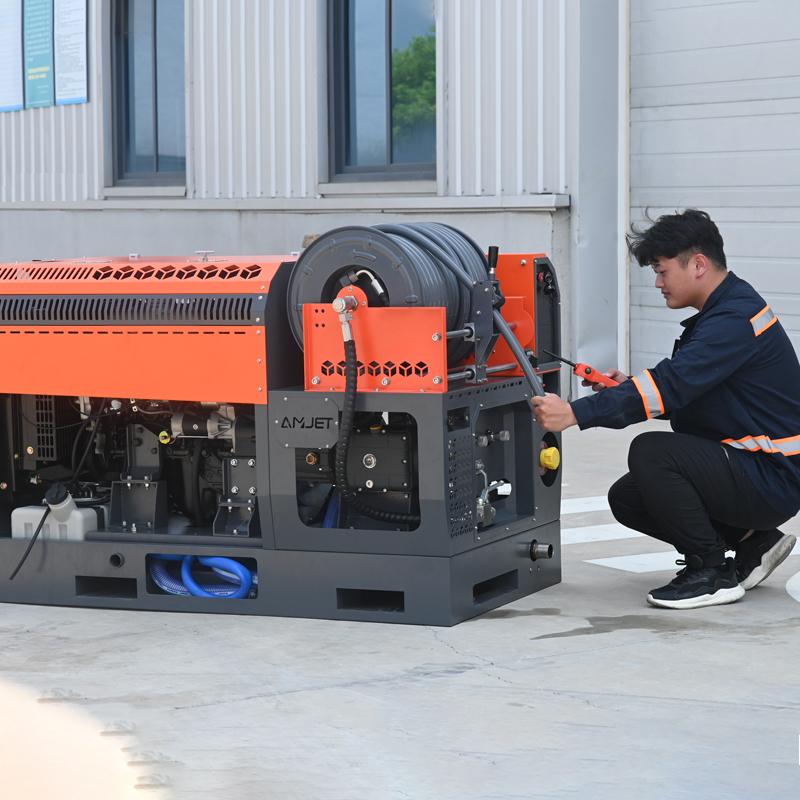
The first thing you notice when comparing a long-life jetting unit to an import is the pump head. On durable units, the manifold is milled from a solid block of 316 stainless or hard-coat anodized aluminum, not a thin die-cast shell. That single change stops the micro-fractures and porosity that let water leak past the plungers after a few hundred cycles. Inside, the plungers are ground ceramic rather than chrome-plated mild steel, so they keep a mirror finish even after running reclaimed water. Seal packs use FKM or PTFE lips with stainless springs, and the brass valve seats are individually lapped—not just stamped and dropped in.
Tolerances separate the two even faster under load. A well-built unit holds bearing bores and plunger bores to within half a thousandth of an inch, which keeps the crankshaft from walking and the pistons from scoring the cylinder walls. The unloader valve on a professional machine is adjustable and rebuildable, with a hardened seat and a balanced piston that reacts in milliseconds—not the fixed, spring-only bypass found on cheap imports. Because of that, you get steady pressure at the nozzle instead of hammering pulses that tear up hoses, fittings, and your wrists.
Finally, the frame and thermal control are engineered, not just welded together. Durable units use thick-wall square tubing with isolation mounts under the engine and pump, so vibration doesn't loosen bolts or crack the baseplate. A thermal relief valve opens automatically to dump hot water when the trigger is released, protecting seals and hoses from heat soak. You'll also see double-bearing crankshafts, stainless check valves, and quick-connect fittings with metal O-ring retainers—details that cost a few dollars more at the factory but save hundreds in downtime and rebuilds.
Real-World Drainage Challenges These Machines Solve Beyond Municipal Sewers
Food processing plants face a draining problem that municipal sewer crews rarely see: animal fats, starch pastes, and fibrous vegetable waste harden inside floor drains and underground interceptors until flow drops to a trickle. A high-pressure jetter paired with industrial vacuum can break through those deposits and pull the waste out before a production line has to shut down. The same combination works in bakeries, dairy plants, and rendering facilities, where hot water alone just pushes the grease further down the line.
On construction and mining sites, the challenge shifts to abrasive sediment. Dewatering sumps fill with bentonite slurry, drilling fines, and crushed rock dust that settle into a concrete-like layer at the bottom. Standard pumps choke, but a vacuum loader with a cyclone separator can continuously remove the sludge, returning cleaner water to the system and keeping discharge limits in check. This is less about clearing a single clog and more about managing a constant inflow of solids.
Then there are the stormwater networks at airports, ports, and rail yards, where sand, tire debris, fuel residue, and de-icing chemicals accumulate in catch basins and oil-water separators. A truck-mounted combination unit can jet the lines, vacuum the trapped waste, and leave the separators functional without manual digging. It is unglamorous work, but it prevents runoff contamination and keeps logistics hubs moving during heavy rain.
Custom Configurations for Niche Industrial and Municipal Applications
Standard off-the-shelf equipment rarely fits the demands of specialized industrial processes or municipal infrastructure with unusual constraints. Custom configurations address factors like non-standard flange patterns, limited access for maintenance, aggressive chemical exposure, or extreme temperature swings that would compromise generic designs. By adjusting materials, sealing systems, and mounting geometries at the engineering stage, these tailored units avoid costly retrofits and premature failures in the field.
In municipal settings, a wastewater treatment plant might require pumps with abrasion-resistant liners to handle grit-laden sludge, plus corrosion-proof hardware for chlorine dosing rooms. Likewise, a remote pumping station with no overhead crane may need a split-case design that allows bearing replacement without full disassembly. Industrial examples include food-grade configurations with crevice-free surfaces and drainable cavities for CIP compatibility, or hazardous-area actuators rated for gas groups rarely covered by standard models.
The real value emerges during the design review, where application engineers map out every wetted part, control interface, and connection point against the site's specific failure history. Rather than forcing a plant to adapt to the machine, the machine is built around the plant's existing piping, power supply, and operator workflows. This approach shortens commissioning time and keeps long-term maintenance straightforward, because every unusual choice has been documented and validated for that particular operating environment.
Why Maintenance Costs Stay Low Over a Decade of Heavy Use
The secret isn't magic—it's a refusal to cut corners where it hurts. Internal components like the drive axle and bearing assembly are machined from case-hardened steel rather than stamped alloy, which spreads wear over a wider surface and resists the micro-fractures that typically force early replacements. Even after thousands of load cycles, these parts show only superficial scuffing, meaning the core structure stays intact and service intervals remain remarkably predictable.
Maintenance cost also stays low because the design deliberately simplifies the points most likely to fail. Sealed-for-life joints eliminate the need for periodic greasing, while modular subframes allow a single worn bushing to be swapped in under an hour without disturbing the surrounding alignment. That means labor bills rarely snowball into multi-day teardowns, and spare parts stay in stock at ordinary suppliers instead of requiring special orders.
Finally, the machine is built with a self-monitoring approach that flags minor issues before they become expensive ones. Onboard sensors track vibration signatures and temperature drift, so a developing bearing wear pattern shows up as a subtle trend, not a sudden breakdown. The result is a decade of heavy use where maintenance spending stays flat—not because nothing ever needs attention, but because the attention required is small, early, and easy to schedule around real work.
From Factory Floor to Field Deployment: What Quality Control Actually Looks Like
Quality control doesn't stop at the factory gate. In the plant, technicians run every unit through a gauntlet of checks—torque tests on fasteners, electrical continuity sweeps, and pressure cycling for sealed components. A bad solder joint or a misrouted cable gets flagged before the housing is even closed. It's tedious work, but it's where most latent failures are caught.
Once equipment ships to a job site, the definition of "quality" shifts. Field crews deal with dust, humidity, temperature swings, and rough handling that no bench test can fully replicate. That's why pre-deployment inspections include not just a visual once-over, but also a short functional run under local conditions. A pump that passed factory calibration might cavitate at altitude; a radio that worked in the lab may struggle next to a running generator.
The handoff between factory and field is the real test. Smart teams use a shared punch list—photos of the final factory inspection travel with the unit, and field techs log any deviation the moment they see it. That loop closes when the next production run incorporates those notes, so the same issue doesn't show up twice. Quality isn't a stamp; it's a conversation between the floor and the field.
FAQ
It comes down to sustained duty cycle and flow rate. A purpose-built sewer jetter can run at full pressure for hours, while a standard pressure washer may overheat after 15-20 minutes. Look for a triplex pump with ceramic plungers and a gearbox drive instead of a direct-drive unit.
For residential lines up to 4 inches, 3000 PSI at 4 GPM is plenty. For larger municipal pipes, you'll want closer to 4000 PSI and 8 GPM to push debris downstream effectively. Don't chase maximum PSI alone; flow does most of the work.
Many operate in industrial clusters where raw materials, hydraulic components, and skilled welders are available nearby. This reduces logistics and labor overhead. Good factories use imported pumps and gearboxes while building frames and reels locally to control costs.
Flush the pump with clean water after every job to remove grit, and check the oil level weekly. Replace nozzle tips when you notice a drop in pressure. Grease all hose reel bearings monthly, and store the unit indoors during freezing temperatures.
Yes, many manufacturers offer configurable setups such as electric start, anti-freeze tanks, and multiple hose lengths. Just specify your truck hitch class and local road lighting requirements before ordering to avoid rework.
At least three: a forward jetting nozzle to break through blockages, a rear-facing flushing nozzle to clear debris, and a rotating root-cutting nozzle for tree roots. Some kits also include a sandblasting nozzle for descaling.
Request a live video walkthrough of the production floor and ask for the serial number of a recent export unit to check with customs records. A serious manufacturer will have no problem sharing test certificates and warranty terms in writing.
Overlooking the import duty classification and forgetting to specify the engine emission standard for their country. Always confirm whether the unit meets EPA or EU Stage V rules. Also, ask for spare parts kits upfront instead of ordering them later.
Conclusion
Over the past decade, China's leading sewer jetting equipment builders have moved well past copying imported designs. They now engineer high-pressure pumps, hose reels, and nozzle systems around actual field failures—not just catalog specs. Instead of thin-walled components found in short-lived imports, these manufacturers use heat-treated plungers, forged ceramic nozzles, and pressure-balanced unloader valves that hold steady at 3,000 to 5,000 PSI. That shift matters when crews face collapsed laterals, grease-hardened restaurant lines, or storm drains packed with construction silt. Beyond municipal sewers, the same machines are configured for petrochemical plants, food processing facilities, and mining sites where abrasive slurry and chemical residue destroy ordinary units. By matching pump displacement to hose diameter and nozzle jet angle, Chinese factories now deliver cleaning power that clears roots and scale without tearing through aging pipe walls.
Custom work is another reason these units hold up. Buyers can specify trailer-mounted or truck-integrated frames, diesel or electric power, hose lengths from 50 to 300 meters, and remote pendant controls for operator safety. Quality control doesn't stop at the factory gate: every pump undergoes hydrostatic testing, each reel is load-cycled, and complete machines are run with water before crating. Field engineers often visit the site for first startup, checking flow rate, pressure drop, and nozzle performance under real conditions. This hands-on approach keeps maintenance costs low over ten or more years of heavy use. Seals, valves, and filters are standard industrial parts, so local mechanics can service them without waiting on proprietary spares. The result is a sewer jetting machine that works in routine drain cleaning and in emergency flood response without the early failure common in disposable imports.
Contact Us
Contact Person: Mike
Email: [email protected]
Tel/WhatsApp: +86 19545555505
Website: https://www.amjeting.com/