
Top FRP Grating Choices for Durable and Safe Flooring
2026-07-15
When it comes to flooring solutions that must endure heavy loads, chemical exposure, and relentless foot traffic, fiberglass reinforced plastic (FRP) grating stands out as a top contender. Yet, not all FRP grating is created equal. Selecting the right type can mean the difference between a long-lasting, safe surface and a costly maintenance headache. In this guide, we’ll explore the top FRP grating choices that deliver durability and slip resistance, whether for industrial platforms, walkways, or corrosive environments. For projects requiring uncompromising quality, Sino Grating offers molded and pultruded options engineered to meet strict safety standards without sacrificing performance. Let’s dive into what makes certain FRP grating products the go-to for builders and engineers worldwide.
Exploring the Best FRP Grating Options for Tough Environments
FRP grating has become a go-to solution in environments that chew through traditional materials like steel or wood. From chemical processing plants to offshore platforms, the combination of fiberglass and resin delivers exceptional corrosion resistance without constant maintenance. It’s not just about withstanding corrosive agents either—these gratings handle temperature swings and UV exposure far better than you'd expect, making them a practical long-term investment in places where downtime is costly.
Molded and pultruded gratings each serve distinct purposes when conditions get rough. Molded variants, with their bidirectional strength and integral grit-top surfaces, excel in areas where traction is non-negotiable, such as slick walkways or trenches carrying aggressive fluids. Pultruded options, on the other hand, offer higher unidirectional load capacity, ideal for long-span platforms or structural decks that bear heavy equipment. Matching the grating type to the specific environmental stress—whether it’s chemical splash, standing water, or constant heavy traffic—can extend service life dramatically.
Key specifications like resin type and surface finish often get overlooked in the rush to solve immediate flooring needs. In acidic settings, a vinyl ester resin stands up far better than standard polyester, while phenolic gratings offer superior fire performance in enclosed industrial zones. Surface treatments, from fine grit to coarse quartz, can be tailored to prevent slips without sacrificing cleanability. Considering both the chemical makeup and physical demands of the environment ensures you end up with a grating that not only survives but thrives under relentless conditions.
Why Molded FRP Grating Stands Out in Safety and Longevity
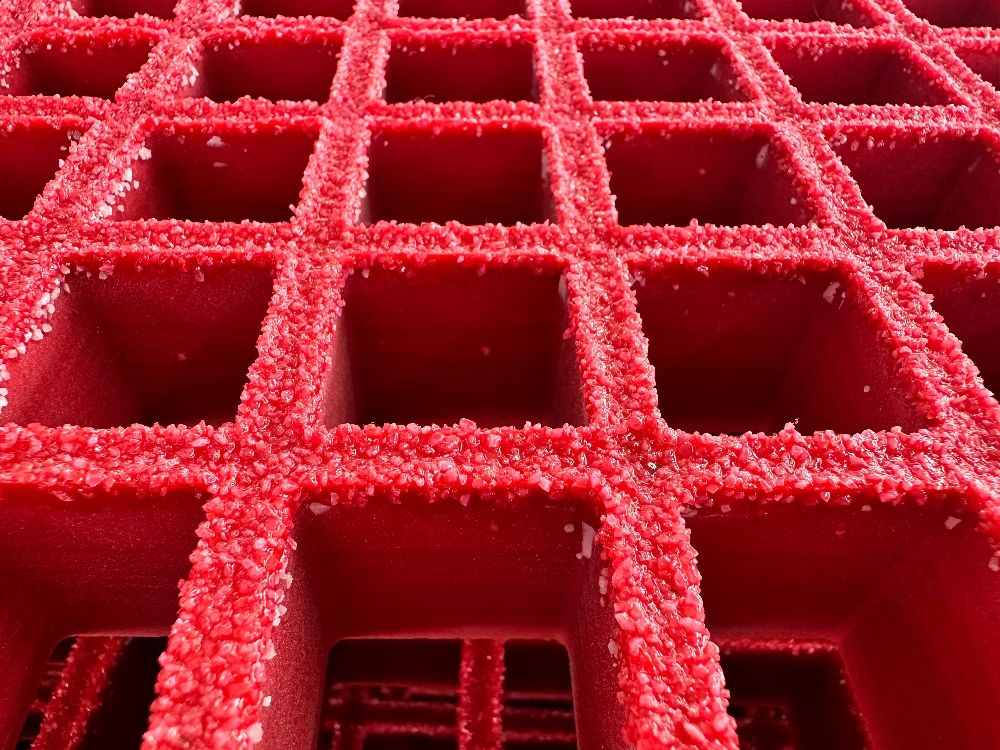
Molded FRP grating is engineered with a unique one-piece construction that delivers exceptional impact resistance and long-term structural integrity, even under heavy foot traffic and rolling loads. Unlike metal grates that can rust, warp, or become slippery, this material maintains a high friction surface for reliable slip resistance in wet or oily environments, reducing fall hazards without relying on temporary coatings.
Its non-conductive and non-magnetic nature adds an extra layer of protection in electrically sensitive areas, while the UV-stabilized resin system resists degradation from sunlight, chemicals, and saltwater exposure. This inherent durability translates to lower lifecycle costs since there’s no need for repainting, rust removal, or frequent replacements—an advantage that becomes clear in bridges, offshore platforms, and wastewater treatment plants where safety cannot be compromised.
Another often-overlooked benefit is how molded FRP grating performs in fire conditions. Many formulations meet strict flame spread and smoke density standards, self-extinguishing without dripping molten material. Combined with its lightweight profile—which simplifies installation and reduces structural dead load—it’s a forward-thinking solution that brings together the safety and longevity features that traditional materials struggle to match over decades of service.
How Pultruded FRP Grating Delivers Strength with Less Weight
Pultruded FRP grating achieves its impressive strength-to-weight ratio through a combination of advanced materials and a precise manufacturing process. The grating is made by pulling continuous glass fiber rovings through a resin bath and then through a heated die, which cures the composite into a solid profile. This pultrusion process aligns the fibers in the direction of load-bearing, maximizing tensile strength while minimizing unnecessary material. The result is a structural component that can withstand heavy loads without the bulk of traditional materials like steel.
Beyond the manufacturing technique, the inherent properties of fiberglass and resin contribute significantly to weight reduction. Glass fibers are inherently lightweight yet incredibly strong, and the resin matrix bonds them together, distributing stress efficiently. The open grid pattern further reduces mass without compromising load capacity. Unlike solid metal plates, the intersecting bars of FRP grating create a high-strength framework that uses less material overall, making it easier to handle, transport, and install while still meeting demanding structural requirements.
In practical terms, this means that pultruded FRP grating often weighs around one-third to one-fourth as much as equivalent steel grating, yet it can support comparable loads. This weight savings translates into lower shipping costs, reduced need for heavy lifting equipment during installation, and less structural support required from the underlying framework. Combined with corrosion resistance and low maintenance, the lightweight strength of pultruded FRP grating makes it an optimal choice for industrial platforms, walkways, and marine environments where both performance and ease of installation matter.
Uncovering the Slip-Resistant Secrets of FRP Flooring
At first glance, FRP flooring might seem like any other durable surface, but its ability to keep people upright in slippery conditions runs deeper than meets the eye. The secret lies in the way manufacturers embed abrasive aggregates directly into the fiberglass resin during production. This creates a coarse, sandpaper-like texture that becomes an integral part of the floor—not a superficial coating that wears off. As a result, every square inch offers consistent traction, whether it's wet, oily, or covered in chemical spills.
What makes this slip resistance truly reliable is that it doesn't rely on a single trick. Unlike epoxy floors with just a topcoat of grip, FRP panels often combine a molded tread pattern with the aggregate so that even as the surface encounters heavy foot traffic, the high points of the pattern help channel liquids away while the underlying roughness continues to bite into soles. This dual-action approach means the anti-slip performance is practically built for life, with minimal degradation over time.
In practical terms, this translates to fewer workplace accidents and greater confidence in environments where slips are a constant threat—from food processing plants to offshore platforms. Independent tests consistently show these floors achieving high coefficients of friction even under extreme conditions, proving that their secret isn't magic but a deliberate marriage of materials science and smart engineering.
Choosing the Right Resin for Chemical and Fire Resistance
The first step isn’t about the resin itself—it’s understanding the full chemical cocktail your composite will face. A tank holding 98% sulfuric acid at room temperature is a completely different beast from one exposed to a mix of organic solvents and intermittent steam purges. Designers often fixate on the primary chemical but overlook trace contaminants and temperature spikes that can accelerate degradation. For instance, even a 10°C rise above ambient can double the corrosion rate in certain polyester resins, while vinyl ester grades might shrug it off. The real trick is to map out the entire service envelope, including cleaning routines and accidental spills, before shortlisting options.
When fire performance enters the equation, the balance shifts. Halogenated resins, like brominated epoxies, deliver excellent flame retardancy but create dense, toxic smoke—a dealbreaker for enclosed spaces such as railcar interiors or offshore modules. That’s where intumescent additives or char-forming phenolics start to look attractive. Phenolics, for example, barely ignite and leave a carbonaceous char that insulates the substrate, but they’re brittle and notoriously tricky to process. A growing trend is to combine low-smoke, low-toxicity epoxy systems with surface veils or coatings that char on exposure, giving you both structural integrity and a compliant heat release profile without the headaches of phenolic layup.
Cross-linking density often gets overlooked but can make or break performance. High cross-link density, typical in many novolac-based products, boosts solvent resistance and thermomechanical stability but makes the laminate prone to microcracking under thermal cycling. This is critical in applications like scrubber ducting, where a hot, acidic airstream meets a cool outer shell. Some manufacturers now offer formulated vinyl ester resins with flexible backbones that endure hundreds of cycles without cracking, while still meeting ASTM E84 flame spread requirements. Testing coupons in advance with the actual chemical mix and heat fluxes—not just coupon immersion—is the only way to avoid an expensive on-site failure.
Real-World Applications That Prove FRP Grating Lasts
FRP grating has been quietly outperforming steel in places where rust eats through metal within months. Walkways at coastal desalination plants see constant salt spray and humidity, yet the FRP panels stay slip‑resistant and structurally sound for over a decade with zero repainting. Maintenance crews actually forget they exist — no scraping, no recoating, just occasional washing.
Chemical plants present an even harsher test. Sulfuric acid drips, caustic spills, and solvent fumes destroy conventional flooring fast. FRP grating installed in battery room platforms and acid storage areas still retains its original gloss and strength after fifteen years of 24/7 exposure. The resin matrix shrugs off corrosion at a molecular level, which means no brittle cracking from pH swings that would crumble concrete.
Offshore oil rigs may be the ultimate proving ground. Between the salt-laden winds, constant vibration from equipment, and the sheer weight of perpetual foot traffic, only FRP grating meets the reliability mark without adding the dead load of heavy steel. Inspectors regularly find grating bars from the 1990s still within load‑bearing spec, the grit top unchanged, and the color just slightly muted — but never compromised.
FAQ
FRP grating is a composite material made from fiberglass reinforced with resin. It creates a strong, non-slip surface that’s resistant to corrosion, chemicals, and moisture—ideal for keeping floors safe in tough industrial environments.
Unlike metal, FRP won’t rust or corrode even in wet or chemical-heavy areas. It’s also lighter than steel, yet still incredibly strong, and doesn’t conduct electricity, making it a safer alternative where electrical hazards exist. Wood rots—FRP doesn’t.
The main types include molded FRP grating, which offers multi-directional strength and excellent slip resistance, and pultruded FRP grating, which is stronger in one direction and often used for longer spans. There are also different resin types (polyester, vinyl ester) for varying chemical resistance.
You’ll want to consider load requirements, chemical exposure, span lengths, and slip resistance needs. For high-traffic areas, molded grating with a gritted surface might be best. In corrosive environments, vinyl ester resin holds up better. Always check the manufacturer’s specs.
Absolutely. With a high strength-to-weight ratio, FRP grating can support substantial weight, including vehicle traffic. It’s designed to handle heavy impacts, and its resilience means it won’t dent or permanently deform like metal might under stress. In harsh chemical or marine settings, it outlasts most materials.
You’ll see FRP flooring everywhere from chemical plants and wastewater treatment facilities to offshore platforms and food processing areas. It’s also popular for pedestrian bridges, catwalks, and even architectural projects where slip resistance and low maintenance matter.
Installation is straightforward—FRP grating can be cut with standard tools, and it’s often secured with clips or bolts. There’s no welding required. Maintenance is minimal: just regular cleaning to remove debris. No painting or rust treatment needed, which saves time and money long-term.
Though upfront costs might be higher than some materials, FRP’s durability means fewer replacements. You’re not spending on painting, corrosion protection, or constant repairs. Plus, its lightweight nature can reduce shipping and installation costs. Over the lifespan of the floor, it’s a smart investment.
Conclusion
FRP grating has become the go-to flooring solution for demanding environments where durability and safety are non-negotiable. Two primary manufacturing methods define the options: molded and pultruded grating. Molded FRP grating, with its bi-directional strength and integral grit-top surface, delivers exceptional slip resistance without extra coatings, making it ideal for areas constantly exposed to moisture, oils, or chemicals. It stands out for its impact resistance and long service life in corrosive settings like wastewater treatment plants and chemical processing floors. On the other hand, pultruded FRP grating offers a high strength-to-weight ratio thanks to its continuous fiber alignment, allowing for longer spans with less material—perfect for lightweight yet heavy-duty platforms, walkways, and catwalks in industrial and architectural applications.
The secret to FRP’s anti-slip performance often lies in the resin and surface design. Gritted or concave meniscus top layers ensure reliable footing, even in wet or oily conditions. Resin selection further tailors the grating to specific hazards: vinyl ester resins provide outstanding chemical and corrosion resistance, while phenolics excel in fire-critical environments with low smoke and toxic emissions. From offshore rigs and food processing plants to pedestrian bridges and water parks, real-world installations consistently prove FRP grating’s ability to endure harsh surroundings without rusting, rotting, or requiring constant upkeep. By carefully evaluating environment, load, traction, and fire or chemical resistance needs, facilities can select an FRP solution that delivers long-term performance and workplace safety.
Contact Us
Contact Person: Nicholas Zhu
Email: [email protected]
Tel/WhatsApp: 18921275456
Website: https://www.sino-grate.com