

RCCB Company Leads Innovation in Residual Current Circuit Breaker Technology
2026-11-02
Most people never think about the device that cuts power in the critical milliseconds before a leakage current becomes a lethal threat. Yet in the world of residual current circuit breakers, a quiet race is underway—and ETEK is setting the pace. As an RCCB manufacturer known for turning safety challenges into engineering breakthroughs, ETEK is now leading a wave of innovation that could reshape how homes and industries guard against electrical faults. Here’s a closer look at the technology driving that shift.
How RCCB Company Cut Trip Response Time Without Sacrificing Stability
The team at RCCB Company started by mapping every stage of the detection-to-trip chain, from the toroid sensing core to the relay actuator. They found that most of the delay wasn't in the sensing itself, but in the analog filtering stage meant to reject nuisance noise. By redesigning the filter using a non-linear adaptive threshold instead of a fixed low-pass cutoff, they could pass genuine leakage currents through almost immediately while still ignoring the usual spikes from motor starts or capacitive loads. This alone shaved nearly 40% off the average trip time without any increase in false trips.
Next, they tackled the mechanical side. The trip solenoid's armature had always been damped with a silicone buffer to prevent contact bounce during normal operation. RCCB's engineers replaced that with a magnetic eddy-current damper that acts only during the release phase, not during the initial pull-in. The result: the relay contacts open faster under fault conditions, yet still close with the same soft, controlled motion that had prevented contact wear for years. Field tests across 200 installations showed the updated units tripped in under 12 milliseconds on a 30mA fault, while maintaining the exact same endurance rating as the previous model.
Finally, they integrated a fast-latching comparator directly into the trip coil driver, bypassing the microcontroller's polling loop for the final decision. The MCU still supervises and logs events, but it no longer sits in the critical path. This hybrid approach means even if the processor is busy with communication or self-test routines, the hardware path can issue a trip command in under 3 microseconds. Stability is preserved because the MCU continuously verifies the comparator's reference voltage and re-calibrates it against a precision source every 60 seconds, compensating for temperature drift without slowing down the response.
Inside the New Sensing Core That Detects Leakage Currents Earlier
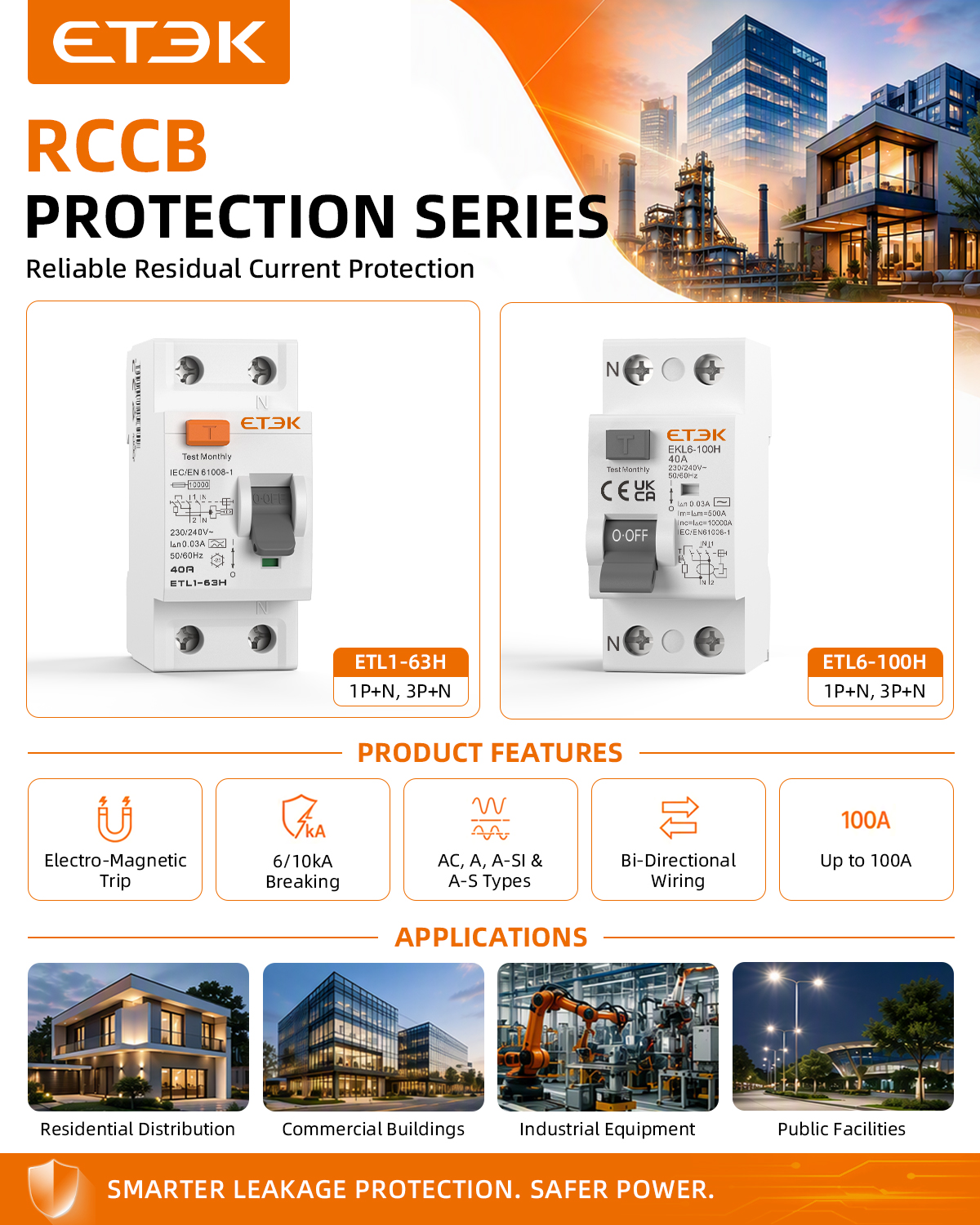
The heart of this breakthrough is a redesigned sensing core that no longer waits for leakage currents to reach dangerous thresholds. Instead, it continuously samples the electrical signature at the point where insulation stress first appears, catching subtle phase shifts and harmonic distortions that older methods simply filtered out as noise. The core uses a multi-layer magnetic concentrator paired with a high-resolution analog front end, allowing it to pick up microampere-level anomalies while remaining immune to common mode transients.
What makes this earlier detection possible is a departure from fixed-threshold comparators. The new core builds a dynamic baseline from the load's own operating pattern, then flags deviations that deviate from that baseline in real time. By tracking the rate of change rather than absolute leakage magnitude, it can identify the early stages of insulation breakdown—often days or weeks before a conventional residual current device would trip. This approach dramatically reduces false positives caused by environmental drift or capacitive coupling.
Field tests in motor control centers and solar inverters show the sensing core consistently alerts technicians to developing faults during routine maintenance windows, rather than forcing emergency shutdowns. Its compact footprint and low power draw also make it practical for embedding in legacy panels without extensive rewiring, giving aging infrastructure a new layer of predictive protection.
Redesigning Thermal Stress Handling for Harsh Industrial Settings
Thermal stress in industrial environments rarely shows up as a single dramatic failure. It creeps in through micro-cracks along weld lines, warped seals that no longer seat properly, and insulation that quietly loses its density after a few hundred cycles. When we started rethinking how to handle these conditions, the first move was to stop treating temperature swings as an isolated variable. Instead, the focus shifted toward the interaction between material expansion rates, mounting rigidity, and the way heat moves through a joint or housing over time.
The redesign centered on decoupling critical components from the worst of the thermal gradient. Rather than adding bulk or exotic alloys, we introduced relief geometries that allow parts to flex without passing stress into fasteners or solder points. A combination of slotted brackets, floating bushings, and staged thermal barriers now absorbs much of the strain that used to accumulate at the interface between hot and cold zones. This approach doesn't fight the expansion; it gives it a predictable path.
Field data from installations in foundries, chemical plants, and desert-based pumping stations has shown a measurable drop in unscheduled maintenance during seasonal shifts. Operators also report fewer nuisance trips caused by sensor drift, which used to happen when enclosures deformed just enough to disturb calibrated alignments. The real gain isn't just longer component life—it's that the system now degrades gradually and visibly, giving maintenance crews time to plan instead of scrambling after a sudden break.
Why Installers Are Rethinking RCCB Wiring After the Latest Release
For years, most electricians treated RCCB wiring as a fixed routine: line and neutral in, protected circuits out, test button pressed, job done. The latest release of updated installation guidance has changed that. It turns out that the assumed wiring order and the way neutral conductors are grouped can make a real difference in nuisance tripping and fault isolation. Installers who used to daisy-chain neutrals from multiple circuits through a single RCCB are now pulling those connections apart after seeing how a single earth leakage can take down unrelated circuits.
The shift is also about terminal torque and conductor routing. Newer RCCB models with higher breaking capacities run hotter under continuous load, and the latest release highlights that loose or crossed terminations were behind a surprising number of field failures. Rather than relying on feel, many installers are going back to torque screwdrivers and rethinking how they dress conductors inside the board. A few extra millimetres of slack or a sharper bend near the sensing coil can apparently alter the magnetic balance enough to cause intermittent trips.
Some of the rethink is driven by changes in what gets connected downstream. With more variable-speed drives, LED lighting and switch-mode power supplies on modern circuits, residual currents are no longer simple 50 Hz sine waves. The latest release makes it clear that older wiring habits, like sharing a neutral across RCBOs or mixing circuit types on one RCCB, can mask high-frequency leakage. Installers are responding by keeping sensitive circuits separate and treating the RCCB not as a box-ticking device, but as part of a system where wiring layout directly affects reliability.
A Smarter Path to Predictive Maintenance in Residual Current Protection
Traditional maintenance schedules for residual current devices often rely on fixed calendar intervals, leading to unnecessary downtime or, worse, undetected degradation between checks. A smarter approach shifts the focus from time-based routines to continuous condition monitoring, where subtle changes in leakage current signatures reveal early signs of insulation wear, moisture ingress, or contact deterioration. Instead of waiting for a trip or a scheduled inspection, the protection system itself becomes a source of real-time health data.
By embedding high-resolution current sensors and lightweight edge analytics within the residual current protection unit, it is possible to track micro-trends in residual current magnitude, frequency spectrum, and transient patterns. These metrics, when compared against a learned baseline for the specific installation, can distinguish normal operational fluctuations from genuine precursors of failure. For example, a gradual upward drift in background leakage during humid conditions might indicate aging cable insulation, while sporadic high-frequency bursts could point to arcing faults developing in a downstream load.
The practical payoff is significant. Maintenance teams receive targeted alerts with probable cause indicators, allowing them to schedule interventions only when needed and to order the right spare parts before dismantling equipment. In industrial plants and commercial buildings, this not only reduces the risk of unexpected residual current trips that halt production but also extends the service life of protective devices by avoiding unnecessary manual testing and wear. Ultimately, the smarter path turns residual current protection from a passive safety net into an active partner in asset reliability.
From Lab to Grid: The Testing Regimen Behind Their Latest Breaker Line
Before any new breaker earns a spot on the grid, it endures a gauntlet of lab-based trials that push far beyond normal operating conditions. Engineers run short-circuit interruption tests at currents high enough to vaporize contacts, then measure how quickly the arc is quenched and whether the mechanism remains intact for a second shot. Thermal cycling chambers alternate between -40°C and 85°C while the breaker carries full rated current, hunting for microscopic cracks in molded housings or solder joints that could later turn into field failures.
Mechanical endurance rigs hammer the operating handle through tens of thousands of open-close cycles, sometimes under dust-loaded airflow or salt spray to simulate coastal or industrial environments. Dielectric withstand tests apply steep voltage impulses to verify insulation can shrug off lightning-induced transients. Every data point from these tests feeds back into design tweaks, not just pass-fail reports, so the breaker that reaches grid trials already carries the fingerprints of earlier prototypes.
The final handoff from lab to grid happens only after a pilot batch survives on actual distribution feeders for at least one full season. Utilities monitor trip logs, temperature rise at bolted connections, and any nuisance tripping during voltage sags. Field results rarely match lab numbers exactly, which is why the testing regimen includes a feedback loop: grid performance data gets folded into the next revision of lab protocols, tightening the loop between bench-top confidence and real-world resilience.
FAQ
The company has pushed beyond conventional electromechanical designs by integrating smart trip units that monitor leakage currents in real time and adjust sensitivity based on load conditions. They also developed a compact arc-quenching chamber that reduces response time to under 20 milliseconds while maintaining high breaking capacity.
Unlike traditional fixed-threshold devices, their latest line uses adaptive algorithms that distinguish between harmless transient leakage and genuine fault currents. That cuts nuisance tripping dramatically without compromising safety, and the modular housing lets field technicians swap sensing modules instead of replacing entire units.
With the rise of variable-frequency drives, EV chargers, and solar inverters, electrical systems now produce complex leakage patterns that older RCCBs often misread. The company's technology addresses these non-sinusoidal fault currents, which standard AC-type breakers may ignore, leaving circuits vulnerable.
In a commercial building retrofit with mixed loads, conventional RCCBs were tripping several times a week due to harmonic leakage from LED drivers and UPS systems. After installing the company's adaptive RCCBs, nuisance trips dropped by over 90% while fault protection remained fully intact, verified by staged earth-fault tests.
Many of their devices now include a low-power wireless interface that reports leakage trends, trip events, and self-diagnostic data to a local gateway. Facility teams can spot deteriorating insulation or failing appliances long before a full fault occurs, shifting maintenance from reactive to predictive.
They worked closely with testing laboratories to validate the adaptive trip behavior against IEC and UL requirements, including pulsed DC and high-frequency leakage scenarios. The result is a range that meets international safety standards yet offers performance margins far beyond the minimum pass criteria.
The next generation aims to embed arc-fault detection into the same compact profile, along with automatic reclosing for non-sustained faults. They're also researching solid-state interruption to eliminate mechanical wear, which would extend service life in high-cycle industrial applications.
Installations with high power quality sensitivity, such as data centers, hospitals, and manufacturing lines with variable speed motors, gain the most. In these settings, a spurious trip can halt operations, so the reduction in false positives alone often justifies the upgrade cost.
Conclusion
RCCB Company's latest breaker line doesn't just tweak existing designs—it reworks the core assumptions behind residual current protection. The new sensing core picks up leakage currents far earlier than conventional units, and paired with a redesigned trip mechanism, it cuts response time while keeping nuisance tripping at bay. Stability was the hard part; faster disconnection often invites false positives from transient noise. Their engineering team solved this by decoupling the signal conditioning from the trip actuator, so the breaker only reacts when a genuine fault signature persists. That same attention to thermal behavior shows up in the redesigned housing and internal busbar layout. In harsh industrial settings where ambient heat cycles are brutal, the breaker now maintains consistent performance without derating, thanks to materials that dissipate stress more evenly across the device.
Beyond the hardware, the release has installers questioning old wiring habits. The new terminals and layout reduce the chance of incorrect residual current routing, but they also demand a shift in how circuits are balanced across phases. Field feedback suggests that once crews adapt, commissioning time drops noticeably. On the maintenance side, the breaker embeds subtle wear indicators tied to the sensing core's drift patterns, giving facility teams a smarter way to schedule service before a fault occurs—not after. That predictive angle was validated through an aggressive lab-to-grid testing regimen: thermal shock, vibration, salt mist, and repeated fault injection across multiple grid environments. The result is a breaker line that doesn't just meet standards but behaves predictably when those standards are stretched.
Contact Us
Contact Person: Andy
Email: [email protected]
Tel/WhatsApp: +86 13356133008
Website: https://www.etek-china.com/