
OEM Mustard Sauce for Your Next Product Launch
2026-11-16
Launching a new product demands more than just a bold idea—it hinges on a condiment your customers won’t forget. If your lineup is missing a signature mustard sauce, HONGBURG FLAVORMAKER brings the OEM expertise to craft a blend that’s unmistakably yours, from tang to texture. Curious how a single sauce can anchor your next launch? Read on.
Rethinking Mustard Beyond the Yellow Bottle
Most people keep a single squeeze bottle of bright yellow mustard in the fridge door and never look further. But mustard has a longer, stranger story than that. From the cracked seeds of ancient Roman tables to the grainy, wine-soaked mustards of Dijon, this condiment has always been more than a hot dog topping. It’s a quiet transformer—sharp enough to cut through fat, sweet enough to round out a vinaigrette, and earthy enough to anchor a marinade. The yellow bottle is just the easiest chapter.
Think of mustard less as a finished sauce and more as a technique. Whole seeds, ground powder, cold liquid, heat, acid—each choice changes the heat, texture, and personality. Brown seeds bring a horseradish-like punch; yellow seeds stay mellow and forgiving. Mix the powder with cold water and wait ten minutes, and the heat blooms. Add vinegar too early and you lock it in mild. That kind of control belongs in a cook’s hands, not on a shelf next to the ketchup.
Once you start playing with those variables, mustard leaves the bun entirely. Whisk a spoonful into melted butter for roasted carrots. Rub a coarse, beer-soaked mustard over pork shoulder before it hits the oven. Fold it into mayonnaise with chopped cornichons for a sandwich that actually tastes deliberate. None of this requires a specialty shop—just a bag of seeds, some vinegar, and a little curiosity. The yellow bottle was never the destination; it was the doorway.
Building a Formula That Survives the Scale-Up
Scaling rarely fails because the core idea was weak. It fails because the original formula leaned on things that don't replicate: a founder's personal network, a manual workaround, a pricing model that only made sense at fifty customers. Before chasing more volume, strip the formula down to the few variables that actually drove early results. If a step can't be documented, automated, or handed to someone new without losing its edge, it's not part of the formula—it's a hidden dependency.
The next test is whether those variables keep their weight as numbers climb. A support process that works with ten accounts might collapse under five hundred, not because support got worse, but because the original feedback loops assumed everyone sat in the same room. Build checkpoints that force the formula to prove itself at 2x, 5x, and 20x current volume. If a variable only survives by adding more headcount or more exceptions, replace it before it becomes the bottleneck. The formula that scales is the one you can explain to a new hire in five minutes and still recognize when operations have doubled.
Choosing a Co-Packer That Understands Condiment Texture
Texture is where most condiment brands stumble, and your co-packer should already know the difference between a glossy drizzle and a stubborn dollop. You want a partner who can talk shear thinning, particle suspension, and mouthfeel without reaching for a glossary. Ask for their work with emulsions, stabilizers, and temperature-sensitive thickeners, then taste the borderline batches where the texture almost broke. That’s where real expertise shows up.
Don’t accept vague promises of “smooth” or “creamy.” Push for specifics: how they handle syneresis in a mustard, prevent phase separation in a vinaigrette, or keep a hot sauce from turning watery after three months on a shelf. A co-packer who understands texture will walk you through their homogenization steps, cooling curves, and even the way they scrape the kettle. If they can’t explain why your sauce thickens differently in winter, keep looking.
The right partner treats texture as a living variable, not a checkbox. They’ll suggest alternative gums or processing tweaks when your formula starts to drift, and they’ll flag ingredient swaps that could ruin the cling on a wing sauce or the snap of a relish. That kind of attention separates a co-packer who merely fills jars from one who actually protects the way your product feels on the tongue.
Packaging Tricks That Make Your Mustard the Impulse Buy
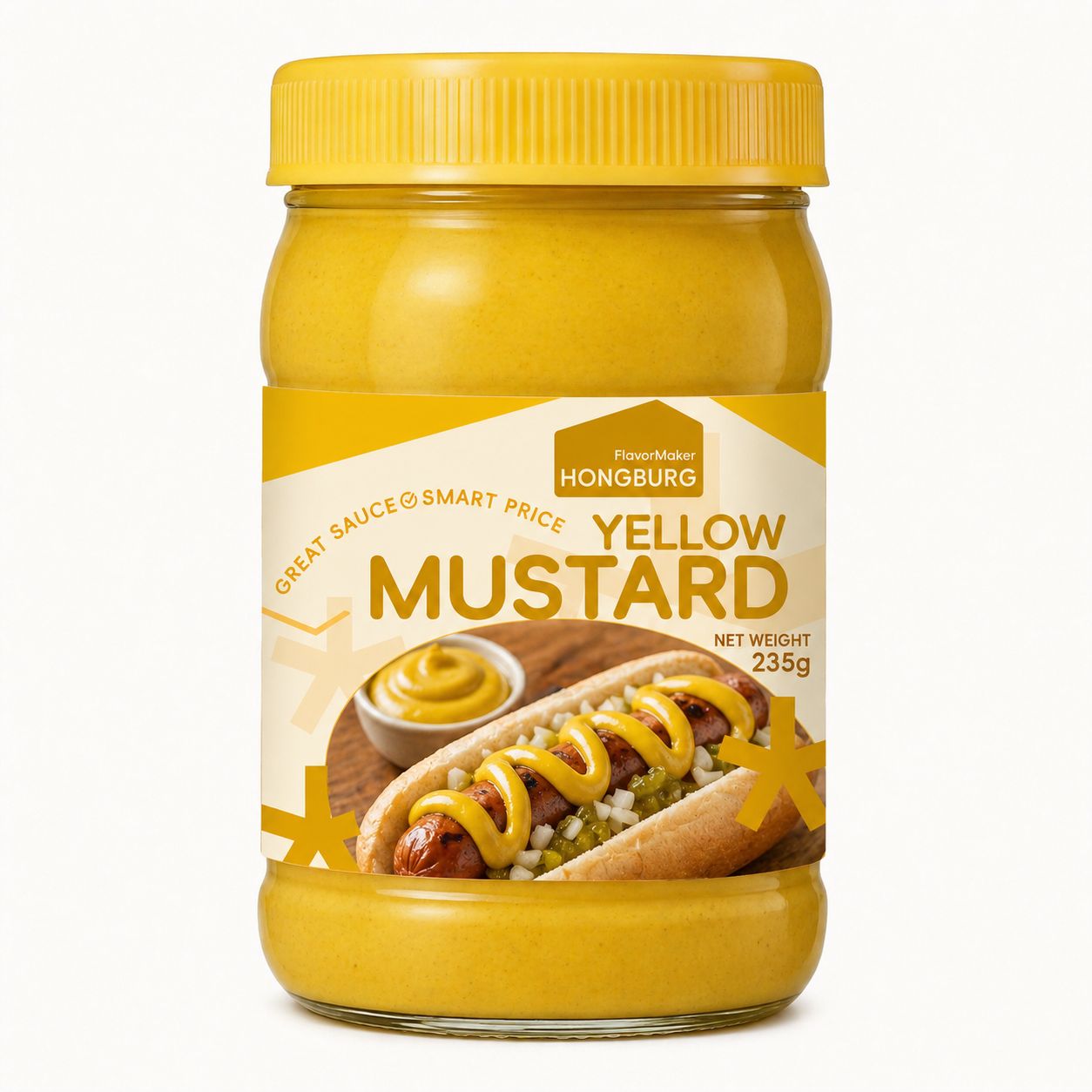
A squat, wide-mouth jar with a bold, almost edible-looking yellow label does more than sit on the shelf—it demands a double take. Consumers scanning condiments rarely read fine print; they respond to shape, color, and the promise of a squeeze that feels rewarding. Jar silhouettes that mimic a small crock or a stoneware pot trigger subconscious associations with homemade, artisanal batches, even if the product came off a high-speed line. The label’s yellow shouldn’t just be yellow—it needs a slight gradient toward an orange-brown edge, as if the mustard itself is trying to escape the paper. That visual tension between containment and overflow is what makes a hand pause mid-aisle.
Clever window placement turns the product into its own advertisement. A thin strip of clear plastic running vertically along the side lets shoppers see the graininess of whole-seed mustard or the silky smoothness of a Dijon, without opening anything. This tiny transparency builds trust, but it also creates tactile curiosity—people want to know if the texture matches the label’s promise. Pair that with a lid that clicks softly when twisted off, louder than expected, and you’ve engineered a micro-moment of satisfaction that feels like the first step of a recipe, not just a purchase. It’s the packaging equivalent of letting customers tap a melon.
Don’t underestimate the power of a single, unexpected word or a hand-drawn illustration tucked near the barcode. A small sketch of a bee, a sprig of tarragon, or a tiny handwritten “batch no. 47” turns a mass-produced jar into a found object. Shoppers who spot these details often smile, and that split-second emotional lift is exactly when the jar goes into the basket. Even the placement of the price sticker matters—angling it slightly or using a matte finish instead of glossy makes the product feel curated rather than stocked. In a category where every brand shouts “tangy” or “bold,” the quiet packaging cues that feel like a secret are the ones that win the impulse game.
Costing Out Your Launch Without Killing Margins
Most launches bleed money because teams confuse activity with progress. They front-load everything—big production runs, expensive launch events, blanket ad buys—and then wonder why margins are squeezed. The fix isn't to slash budget arbitrarily; it's to treat every launch cost as a bet that must pay back within a defined window. If a line item doesn't either pull in revenue quickly or reduce risk meaningfully, it doesn't belong in the first tranche.
Start with a baseline cost sheet that separates fixed obligations (contracts you can't wiggle out of, minimum inventory orders) from adjustable spending. Then set a hard floor for your gross margin—say, 40%—and run every proposed expense through that filter. If a spend would push the launch below that floor, you either renegotiate it, defer it, or kill it. Keep 15-20% of the total budget unallocated for the first two weeks; that buffer lets you double down on what's working without borrowing from future profits.
Rather than funding broad awareness campaigns, put money where the purchase decision actually happens: targeted samples, limited-time introductory offers, and direct outreach to high-intent buyers. Track spend-to-revenue ratios daily during the first ten days, and don't hesitate to cut anything that isn't clearing its own weight. A launch that costs less but converts well beats a loud launch that vanishes after week one.
Timing Your Market Entry When Shelves Are Hungry for New Flavors
Retail buyers rarely admit it directly, but empty shelf space creates a quiet pressure that can work in your favor. When a category has gone stale—same flavors, tired packaging, no visible innovation—store managers start looking for something to break the monotony. That window isn't announced in a newsletter. It shows up as a gap between existing products, a seasonal reset, or a distributor mentioning that a competitor just pulled out of three locations. If you're still perfecting your formula while that gap exists, you're already late.
The trick is to match your production readiness with the rhythm of retail calendars. Most independent grocers and specialty chains do major resets twice a year, often right after the holiday rush and again in early fall. But don't wait for a formal reset invitation. Walk the aisles yourself. If you notice three barbecue sauces and none of them offer a smoky-sweet blend that actually tastes like smoke, that's your signal. Approach the buyer with a concrete proposal: one SKU, a tight margin, and a story about why that flavor fills a specific hole. Buyers don't want another option. They want the option that makes their shelf look curated rather than random.
Speed matters, but so does restraint. Launching into a crowded category with a me-too flavor just because there's a temporary shortage won't build staying power. Instead, watch for shelves where demand has shifted faster than supply—think regional tastes migrating into new markets, or a viral recipe driving consumers toward an ingredient nobody stocked six months ago. If you can get a small batch on the shelf within four to six weeks of spotting that shift, you become the brand that was already there when everyone else caught up. That timing, more than any ad spend, is what turns a one-time placement into a permanent home.
FAQ
We start with your target profile—flavor, texture, heat, color—then develop samples in our pilot kitchen. You approve the final version before we scale it to production. Packaging, label, and logistics run in parallel so you're not waiting on a single thread.
Both. If you already have a recipe, our food scientists can reverse-engineer it for consistent scale-up. If you're starting fresh, we have a library of stone-ground, Dijon, honey, and spicy bases we can tweak to your market.
For glass jars and squeeze bottles, we usually start around 1,000 units per SKU. For portion packs or sachets, the minimum is higher because of run efficiency—typically 10,000 packs. We can recommend the right format based on your channel.
We document every ingredient source and use inline pH, viscosity, and capsaicin checks during production. A retained sample from each batch is kept for 18 months, so if a customer question comes up, we can pull the exact lot.
For retail, we see a lot of traction with 9-ounce glass jars and upside-down squeeze bottles. For foodservice or meal kits, single-serve pouches and portion cups reduce waste and speed up service. We can also do custom labels, tamper-evident seals, and case packs.
Yes. We have formulations that are gluten-free, vegan, non-GMO, and free from artificial preservatives. If you need an organic line, we can source certified ingredients and run a dedicated line to avoid cross-contact.
Most of our mustard sauces carry a 12- to 18-month shelf life from the production date. Keep them in a cool, dry place before opening; after opening, refrigeration is recommended. We'll run accelerated shelf-life testing if you want a longer claim.
A standard launch takes about 8 to 10 weeks: two weeks for sample development and approval, four weeks for packaging and label proofing, and two to three weeks for production and freight. Rush orders are possible for an added fee, but we prefer not to cut corners on quality.
Conclusion
Launching an OEM mustard sauce means pushing past the classic yellow squeeze bottle and thinking about how texture, heat, and acidity can set a product apart. A memorable formula often hinges on whole seeds, unexpected vinegar blends, or a slow-building heat that lingers rather than shouts. But a great bench-top recipe doesn't automatically survive large kettles and high-speed filling lines. You need a partner who has run emulsified condiments through real production equipment, because separation, grittiness, or a thin, watery mouthfeel can destroy the experience by the time it reaches a shelf. Co-packers with experience in sauces and dressings will ask the right questions about particle size, shear, and pH stability before you commit to a run.
Packaging deserves the same attention as the recipe. A squat jar, a squeeze pouch with a matte label, or a clear window that shows off visible seeds can turn a curious shopper into a buyer within seconds. At the same time, every packaging upgrade needs to justify itself in the cost model. Work backwards from a target retail price and acceptable margin, then challenge each component—cap, label stock, fill weight, case pack—to earn its place. Finally, timing matters as much as taste. Smaller brands can move faster than the big players, so watch for flavor gaps in the category: a hot honey mustard, a smoked apple mustard, or a fermented rye mustard can land when buyers are actively looking for something new. Launching into that gap, with a formula and package that hold up under real production, is the difference between a one-time novelty and a repeat purchase.
Contact Us
Contact Person: Peter Song
Email: [email protected]
Tel/WhatsApp: +86 18920189778
Website: https://www.hongburg.com