
Men’s Business Casual Socks Company Guide to Comfortable All Day Style
2026-11-17
Men’s business casual socks rarely get much thought until they slip, bunch, or feel too warm by noon. This guide flips that habit. Instead of treating socks as a placeholder, we looked at the choices that separate all-day comfort from a morning-only polish—using KINDWAY as our reference for how materials, fit, and low-key pattern can work together. If you’ve ever wondered why some pairs stay comfortable through back-to-back meetings while others don’t, the rest of this guide is for you.
Noon Is Where Most Socks Fall Apart
By mid-morning a sock still has enough structure to hold its shape, but the moment lunch approaches the damage starts showing. Heat builds inside the shoe, the weave softens, and the same spot near the heel or the ball of the foot has already been rubbed thousands of times since breakfast. That is why noon is less a time of day and more a threshold.
What happens at noon is not dramatic. A thread slips, a thin patch opens, or the elastic gives up without a sound. Feet swell slightly as the body warms toward midday, tightening the fit and forcing the fabric against every rough edge in the shoe. A sock that survived the cooler, slower morning often cannot handle the warmer, busier middle of the day.
The failure rarely announces itself. One step feels normal, the next step you feel bare skin against the insole. The split may be small enough to ignore at first, but by the end of the day it has widened into a reminder that the middle of the schedule is where small weaknesses get punished.
Feet Sweat, Even When the AC Works
A chilly office or a breezy living room can still leave your socks damp by noon. The thermostat might read 68 degrees, yet your feet act like they are running their own private summer. This disconnect usually points to how footwear traps moisture and heat instead of letting either escape. Synthetic linings, thick soles, or snug lacing patterns hold warmth close to the skin, so cool air from the vent never reaches the parts that need it most.
Sweat glands on the soles respond to pressure and stress just as much as temperature. Sitting still under a desk with crossed legs or wearing the same pair of shoes from morning commute to evening errands keeps those glands active. The body also releases moisture through the feet when core temperature shifts slightly, even if the room feels comfortable. Without breathable materials or a chance for air to move through the shoe, that moisture has nowhere to go.
A practical fix starts with swapping dense socks for merino wool or open-weave cotton blends, which pull moisture away instead of holding it. Choosing shoes with mesh panels or perforated leather gives cool air a path inward. Rotating between two pairs so each can fully dry overnight also breaks the cycle better than any thermostat adjustment will.
The Right Ribbing Won't Leave Marks
The problem with most ribbing isn't that it stretches too little; it's that it recovers too aggressively. A well-made ribbed cuff or hem gives just enough to follow your movement, then settles back without pinching the same line of skin all day.
Wider ribs and flat interior seams help distribute contact more evenly, so the pressure never concentrates in one narrow groove. That is why the same size can feel completely different between two brands, even when the fabric content looks identical on paper.
If you want to avoid marks, test the edge before buying. Stretch it gently and watch how it returns. A smooth, gradual recovery and a soft inner surface usually mean it will stay comfortable long after you stop thinking about it.
Quiet Patterns, Confident Desk Presence
A faint herringbone on a desk mat or a narrow pinstripe along the edge of a notebook does something subtle to the way a workspace feels. It gives the eye a place to land without announcing itself. The pattern registers more as texture than decoration, so the desk never looks busy. That restraint tends to carry into how someone sits down, sets a coffee mug aside, and starts the first task without drama.
There is a particular confidence in surfaces that do not try to prove much. Pens lie parallel, cables disappear behind a monitor riser, and one muted check or tone-on-tone dot repeats just enough to feel intentional. It is not about bare minimalism or matching every object. A single quiet pattern can act like a low, steady pulse under the whole setup, making the space feel settled rather than staged.
What others often read as calm is really a kind of editing. The person at that desk has removed visual noise and kept only what supports focus. That choice shows up in the way they speak, answer questions, or wait through silence. The desk does not interrupt, so the presence behind it becomes easier to trust.
One Pair Should Make It to Dinner
The best test of a pair isn't the mirror at noon. It's whether you still want them on at eight p.m. when the table is set and the lights are low. A pair that can make it to dinner doesn't demand a costume change or a backup plan. It just needs to hold its shape, keep its color from shifting under restaurant lights, and feel as composed after a commute as it did at the front door.
That usually comes down to small details: a sole that doesn't turn stiff after a long sit, a heel height that doesn't punish you on pavement, and a finish that looks better with a few creases. If a pair can survive a full day and still look deliberate by the time menus arrive, it has earned its place.
Wash Day Shouldn't Undo the Shape
If wash day keeps turning your defined waves into a shapeless cloud, the issue usually isn't the water or the cleanser itself. It's the sequence. Raking product through soaking wet hair and then scrubbing with a towel will undo every bit of structure you've built. Instead, treat the cleanse as a light reset for the scalp, not a full dismantling of the hair's natural pattern. Keep the lengths mostly undisturbed, let the water run through rather than piling hair on top of your head, and you'll notice the shape survives the rinse.
What you apply immediately after matters just as much as what you wash with. While the hair is still dripping, smooth a leave-in or curl cream over the outer layer with open palms, then gently press upward to encourage the original bends and coils to reform. This is the moment to re-set the silhouette. Don't rake your fingers through; use flat hands and a slow scrunching motion so the strands remember where they belong.
Drying can either lock in the shape or erase it. A rough cotton towel pulls apart the pattern and creates frizz that reads as shrinkage and flatness. Use a microfiber cloth or an old t-shirt to press out excess water, then either air-dry without touching or use a diffuser on low speed and low heat. Lift sections from the ends with the diffuser bowl and hold for a few seconds before releasing. The result should feel like wash day preserved your shape, not started it over.
FAQ
It sits between the two extremes. Business casual socks usually have a finer knit than gym socks but more texture or pattern than a plain formal pair. They are meant to pair with chinos, wool trousers, denim, and leather shoes without looking overly shiny or too sporty.
A blend with merino wool, combed cotton, or bamboo works well. Merino handles temperature and moisture, cotton gives a smooth feel, and a little nylon or elastane helps the sock keep its shape through hours of sitting, walking, and commuting.
Mid-calf or over-the-calf are the safest choices. They stay up and do not expose skin when you cross your legs. Ankle socks can work with slim chinos and sneakers, but they tend to slide down more often with loafers or oxfords.
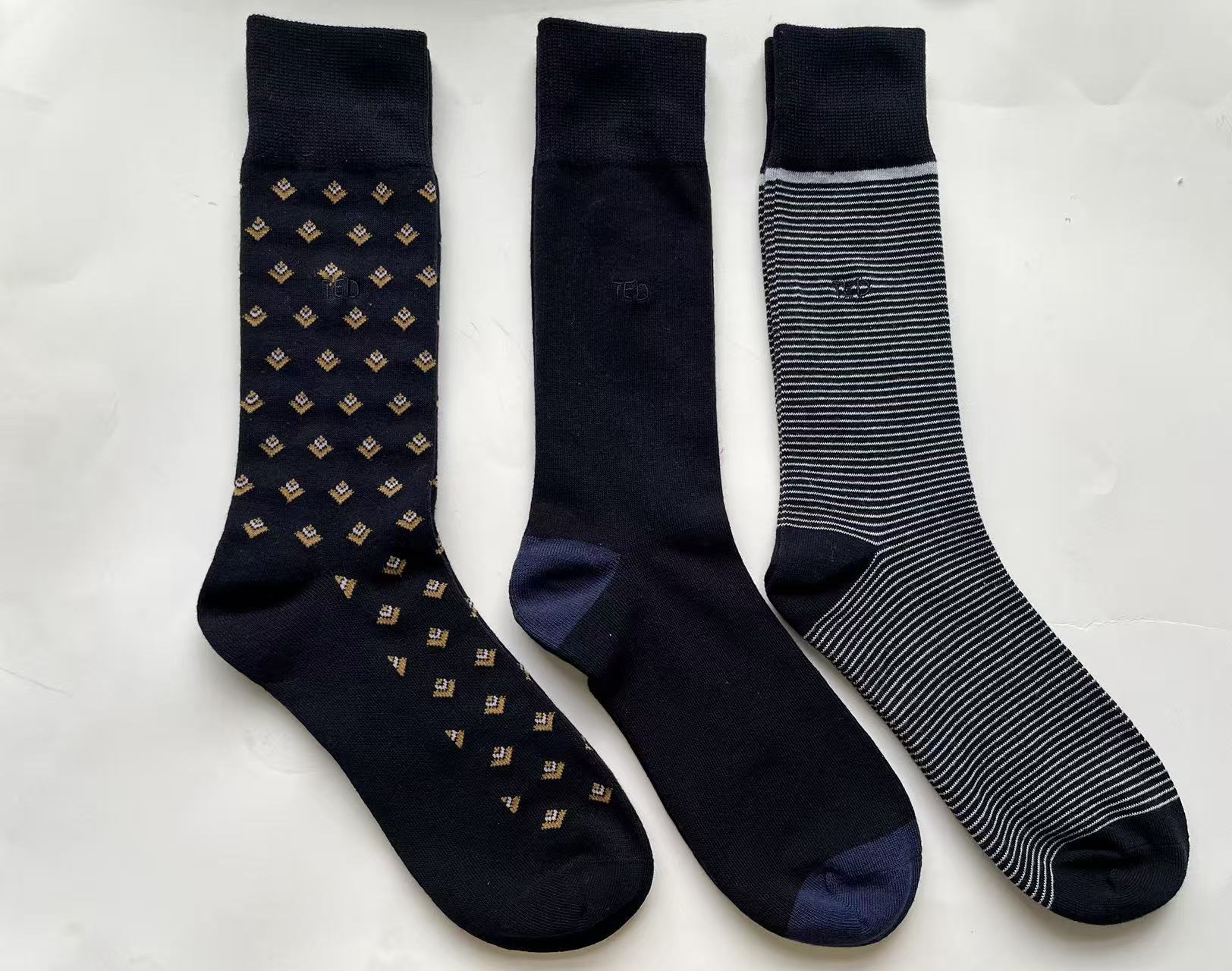
Yes, but think subtle first. Small geometric prints, tone-on-tone stripes, or deep colors like burgundy, olive, and navy are easier to style. Save bright novelty prints for casual days or when your outfit is intentionally quiet.
Around five to seven pairs is enough for a typical workweek if you rotate them and let them rest between wears. More if you travel often or prefer not to do laundry midweek.
Check the sizing and the elastic content. A proper fit around the arch and calf matters more than most people expect. Socks with a reinforced heel and a bit of nylon or elastane usually grip better and keep their shape longer.
Not necessarily. Light cushioning under the foot can be hidden well as long as the upper looks neat. Avoid heavy terry padding that makes the sock look thick and athletic. A comfortable sole does not have to change the silhouette.
Wash them inside out in cool or lukewarm water and avoid high heat in the dryer. Heat breaks down elastic over time. Let them air dry when possible, and skip fabric softener because it can coat the fibers and reduce breathability.
Conclusion
Most socks can survive the morning, but noon is where the real test begins. We build our business casual pairs with a denser heel and toe so they do not bag out or slide down after a few hours at a desk. Because feet sweat even in climate-controlled offices, we use a breathable cotton-merino blend with a wicking inner layer; that keeps the day from turning damp and heavy by mid-afternoon. The ribbing is tuned to stay up without digging into the calf, so you do not end the day with red marks above your socks. Light compression through the arch adds just enough structure to keep the fit steady without making your feet feel trapped.
Style matters just as much as comfort when you are moving from a meeting to dinner. The patterns are deliberately quiet: small checks, heathered solids, and narrow stripes that read well at the office but do not demand attention under a table. One pair should look intentional with tailored trousers and still feel appropriate with dark denim later. After washing, a reinforced cuff and pre-shrunk fibers help the sock return to its original shape instead of twisting or stretching out. That means fewer pairs get retired early, and the pair you grab on a busy morning already feels broken in, not worn down.
Contact Us
Contact Person: Alfred Lee
Email: [email protected]
Tel/WhatsApp: +86 13806701496
Website: https://www.hainingsocks.com/