

How a Coconut Shell Activated Carbon Company Supports Cleaner Air and Water
2026-11-21
Most conversations about cleaner air and water stop at the visible problems, but the real work often begins with materials we rarely see. Tundrr has been turning coconut shell waste into high-performance activated carbon, helping industries remove impurities without adding unnecessary complexity. In this post, we look at how that process supports safer air and water, and why the source of your filtration media matters more than expected.
Turning Coconut Shell Waste into a High-Value Filtering Material
Coconut shells are usually tossed aside after the flesh and water are harvested, but their dense, microporous structure makes them surprisingly well-suited for filtration. When heated slowly in a low-oxygen environment, the shells turn into a hard carbon with countless tiny channels and crevices. These irregular pores catch fine particles, dissolved impurities, and even some heavy metals as water passes through. Unlike softwood-based carbons that crumble under pressure, coconut shell carbon keeps its shape longer, which means fewer fine dust particles escape into the filtered liquid.
The shift from waste to filter media starts with cleaning and crushing the shells into uniform granules, then activating them with steam or mild chemical agents to open up more surface area. A single gram of well-activated coconut carbon can expose hundreds of square meters of internal surface, yet the manufacturing cost stays low because the raw material is abundant and often free. Small-scale workshops in coastal regions have begun pairing this process with local water treatment systems, turning a disposal problem into a practical supply chain for point-of-use filters.
What makes the material stand out is not just its performance but the way it closes a loop. Instead of importing synthetic resins or mined minerals, communities can produce reliable filter media from something already piling up near markets and processing plants. The resulting carbon performs well in household pitchers, aquaculture tanks, and even smoke-removal units, while the leftover ash and fines can be mixed into compost or lightweight building blocks. That layered usefulness keeps the value in the community rather than shipping it away as waste.
Why Coconut Shell Carbon Works So Well for Gas and Odor Removal
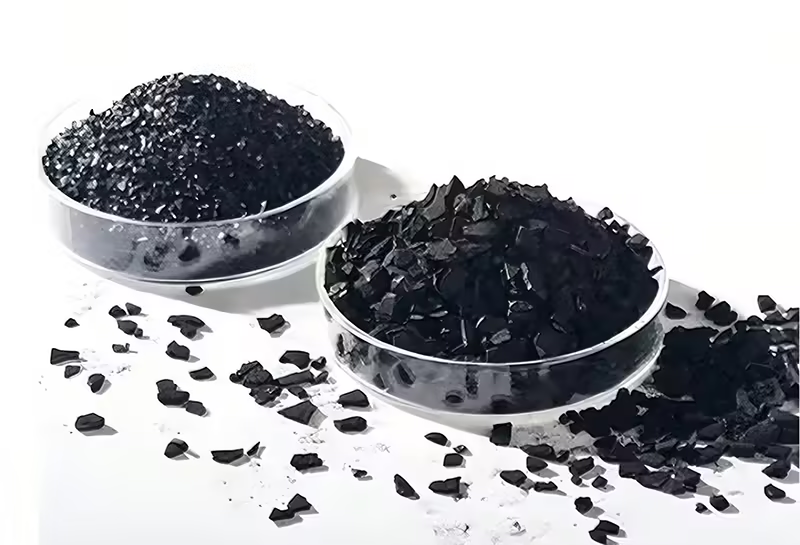
Coconut shell carbon picks up gas molecules that many other filter materials simply miss. Its high microporosity means the internal surface is packed with tiny pores mostly under 2 nanometers wide, which lines up well with the size of common odor-causing compounds like hydrogen sulfide, ammonia, and short-chain volatile organics. That size match allows weak van der Waals forces to hold the molecules in place instead of letting them pass through.
Another reason is the raw material itself. Coconut shell tends to produce a hard, low-ash carbon with a relatively clean pore structure, so there is less interference from mineral residues during physical adsorption. Once activated with steam under controlled conditions, the resulting carbon develops a dense network of micropores without becoming crumbly, which keeps pressure drop stable and gives a long service life in gas-phase filters.
Cleaner Air Starts with the Right Pore Network
Air quality inside a space often depends on things we rarely see: the microscopic channels and voids within filtration materials. These tiny openings, known as the pore network, decide how effectively particles are captured while still allowing air to move freely. When the pores are too large, contaminants slip through; when they are too narrow, airflow drops and energy use climbs. Getting that balance right starts with understanding the geometry of the material itself.
A well-designed pore network does more than just trap dust. It distributes airflow evenly, reduces pressure drop, and extends the usable life of the filter. Think of it like a city road system: if every street is the same width, traffic either bottlenecks or speeds through without stopping. Varying pore sizes and connecting them in the right way creates a more forgiving structure that captures particles of different sizes without forcing the fan to work harder.
The goal is not simply to make pores smaller but to shape them so they work together as a continuous, breathable maze. This means considering pore shape, wall thickness, and interconnectivity from the very first design stage. When these elements align, cleaner air becomes a natural outcome of the material’s internal architecture rather than a constant battle against airflow resistance.
From Municipal Water to Industrial Effluent: Where It Fits
Municipal treatment rarely offers the luxury of a stable feed. Raw water quality shifts with runoff, algal blooms, and seasonal turnover, so any unit process placed here has to absorb those swings without falling out of spec. That often means handling moderate organic loads while keeping disinfection by-product precursors, taste and odor compounds, and residual turbidity in check before the water reaches distribution.
Industrial effluent is a different animal altogether. Flow and composition can change by the hour, with pH spikes, solvent traces, heavy metals, or recalcitrant organics that do not respond to conventional biological treatment. In these settings the same core technology tends to work best as a roughing step ahead of biological systems or as a polishing step after them, pulling out the fraction that would otherwise poison downstream biology or push discharge limits over the edge.
That spread from municipal water to industrial effluent leaves a practical middle ground: reuse and resource recovery. Facilities on either side increasingly need to turn marginal water into something usable again, whether it is cooling tower makeup, process wash water, or indirect potable supply. The fit is less about a single ideal application and more about matching removal capacity to the real variability of the water in front of you.
What Happens in Quality Control Before the Product Ships
In the days before anything leaves the warehouse, quality control shifts from checking boxes on a list to actually trying to break the product in small, controlled ways. Incoming components are measured against retained samples, and assembly lines get audited at random intervals for things like torque drift, seal gaps, or inconsistent labeling.
Finished units are pulled in batches and put through functional tests that mimic the worst of normal use, not just the ideal demo. Depending on the item, that might mean repeated lid openings, temperature swings, drop simulations, or leak checks. Units that fail are quarantined while the line is adjusted, and the root cause is recorded instead of just scrapping the part and moving on.
A shipment only clears when the first article, in-process checks, and final batch samples all tell the same story. If a result is borderline, the cartons stay on hold until the issue is understood or the lot is reworked. That slowdown costs time, but it is cheaper than chasing returns later.
Renewable Sourcing That Reduces the Footprint of Purification
Most purification discussions start with yield, host cell protein clearance, or resin lifetime. Energy rarely enters the room until a site expansion forces the issue. Yet chromatography skids, tangential flow filtration rigs, and clean-in-place systems often pull more steam and electricity than the bioreactors upstream. Tying those loads to renewable power and biomass-generated steam through regional purchase agreements shifts the carbon profile of every polished batch. It also creates an operational reason to schedule buffer preparation and column equilibration during periods when wind or solar output is highest.
The sourcing angle goes beyond the utility bill. Resin vendors, filter manufacturers, and solvent suppliers carry their own purification footprints in polymer production, ligand chemistry, and transportation. Choosing suppliers that run energy-intensive steps on renewable grids or offer resin regeneration and membrane take-back programs removes emissions that never appear in a facility’s direct metering. At the same time, switching to high-capacity resins, single-pass tangential flow filtration, or buffer concentrates lowers the volume of water and chemicals that must be heated, chilled, and treated. That makes the renewable energy go further because there is simply less purification demand to power.
Where this becomes more than a procurement checkbox is in the numbers attached to specific unit operations. A site can map a solar array to ultrafiltration and diafiltration loads or link a biogas boiler to CIP and column cleaning cycles, then track avoided emissions per gram of product. Those figures tend to stick in batch records and capacity planning in a way that broad corporate offsets do not. Once purification teams see the cost-per-gram benefit of cleaner steam and lower buffer volumes, follow-on projects like heat recovery from waste streams or closed-loop water reuse become easier to justify.
FAQ
Coconut shells yield a very hard carbon with a high proportion of micropores, which gives it strong adsorption at low concentrations. It also repurposes an agricultural byproduct that might otherwise be burned or dumped, so the raw material has a lighter environmental footprint than mined coal.
It removes chlorine, taste and odor compounds, and a range of organic contaminants by adsorption. Water passes through a bed of carbon, and dissolved molecules are pulled into the pore structure. Some grades are also effective at reducing disinfection byproducts and trace pharmaceuticals when combined with proper pretreatment.
For air streams, the carbon captures volatile organic compounds, hydrogen sulfide, and other odorous or hazardous gases before they leave a facility. The company often helps size the filter bed, selects the right mesh and impregnation, and can run pilot tests to estimate how long the media will last under real conditions.
It has a genuine sustainability advantage because the shells are a byproduct of coconut harvesting for food and oil. Using them avoids opening new coal mines and gives the agricultural waste stream a second life. The main environmental cost is the energy used during carbonization and activation, which responsible producers try to reduce with heat recovery and efficient kilns.
They test for iodine number, hardness, moisture, ash content, and particle size distribution. Batches are blended only after those values fall within tight ranges. For drinking water applications, they also verify compliance with standards like NSF/ANSI 61 and keep traceability back to the raw shell source.
They are usually different. Water treatment often uses finer mesh sizes for faster kinetics and lower pressure drop constraints, while air treatment may need larger granules or pellets to control backpressure. Impregnated carbons are sometimes used for gases like H2S or mercury, but those impregnants are not always suitable for potable water.
Depending on the application, it can be thermally reactivated. The adsorbed organics are destroyed at high temperature under controlled conditions, and the carbon can be reused. If reactivation is not practical, some spent carbon is used as fuel in cement kilns, but the company generally designs systems to make reactivation the first option.
Conclusion
Coconut shell activated carbon starts with a material most processors treat as disposal. Charred under controlled conditions and activated to open a tightly packed micropore structure, the shells become a filter media with an unusually large internal surface for its weight. That pore network is what makes the product effective against airborne contaminants: short-chain odors, volatile organics, and sulfur compounds lodge inside pores rather than passing through. Air handling systems fitted with this carbon can strip nuisance smells and hazardous vapors without relying on heavy chemical dosing, which keeps maintenance simpler and reduces secondary waste.
The same material crosses into water treatment without changing its basic character. Municipal plants use it to pull taste and odor compounds from drinking water, while industrial operators apply it to complex effluent streams that contain solvents, dyes, or trace metals. Before any batch leaves the facility, sieving, hardness testing, ash content checks, and adsorption challenge tests confirm that it will perform under real operating conditions. Because coconut shells regenerate yearly and would otherwise rot or burn as farm waste, sourcing them also lowers the environmental load of purification, making cleaner air and water less dependent on mined coal or slow-growing timber.
Contact Us
Contact Person: Ellen Zhang
Email: [email protected]
Tel/WhatsApp: +86(21) 2287 6756
Website: https://www.tundrr.com/en/