

Chocolate Ball Mill Manufacturer Selection Guide for Reliable Grinding and Refining
2026-11-17
Choosing the right chocolate ball mill can feel like navigating a maze of specs that all start to look the same. But the difference between a smooth, perfectly refined batch and a gritty, inconsistent one often comes down to the manufacturer behind the machine. In this guide, we cut through the noise to show what actually matters for reliable grinding and refining — with a close look at how GUSU approaches the challenges that trip up so many production lines.
Where Grinding Precision Starts Before a Single Batch Runs
Precision in grinding rarely begins at the machine. It starts in the quiet decisions made beforehand: how a fixture is seated, how wheel wear is tracked across shifts, how room temperature is logged against the thermal expansion of a spindle. These details rarely make it into a spec sheet, but they show up in every finished surface.
A shop that takes pre-run checks seriously will measure incoming blanks, record coolant concentration, and map the previous batch's dimensional drift before the first part is loaded. That history acts like a tuning note. Without it, even the most expensive grinder becomes guesswork wrapped in servo motors.
The real advantage shows when a new operator steps in mid-order and finds the setup notes, wheel dressing intervals, and compensation offsets already waiting. Grinding precision becomes less about heroic adjustments and more about keeping a chain of small, deliberate choices intact long before the spindle ever spins up.
Why Thermal Drift Quietly Changes Chocolate Viscosity
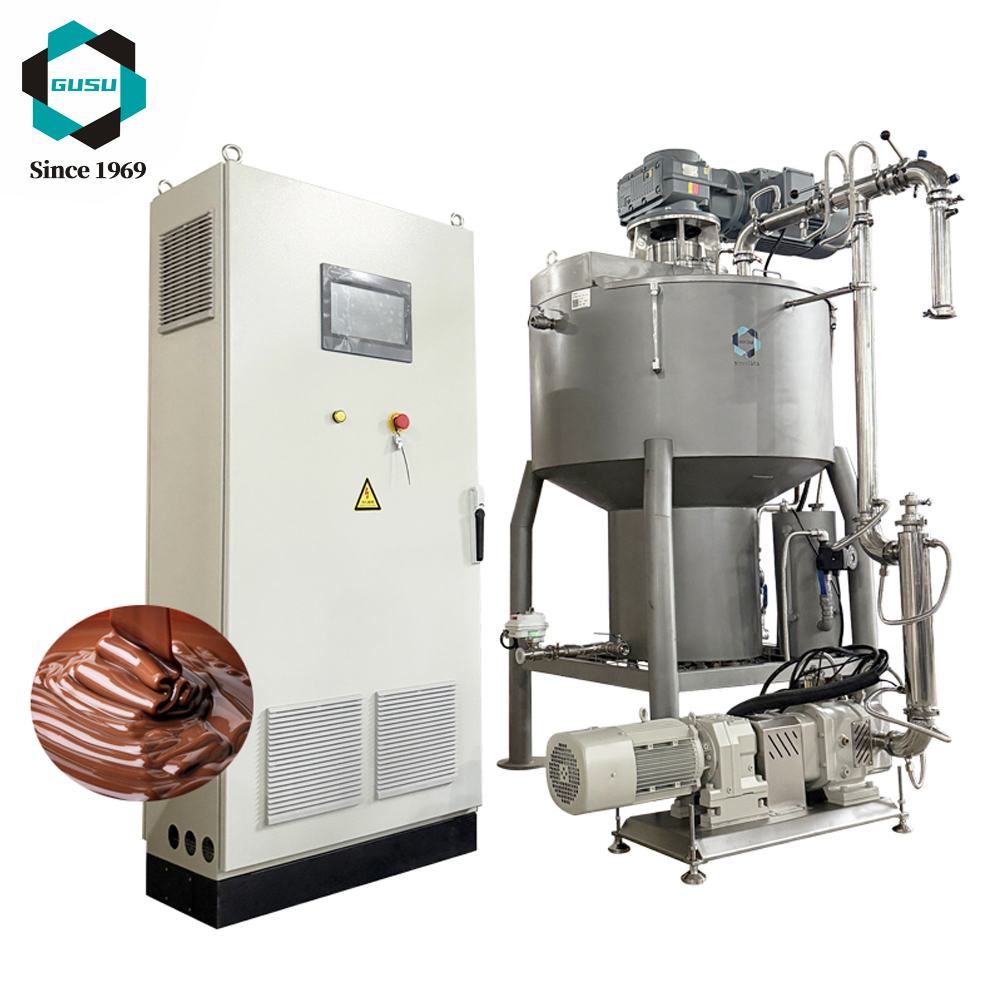
Chocolate that holds a steady temper at 31°C can still drift in viscosity when the room or the enrobing line shifts by less than a degree. Cocoa butter is never fully solid or fully liquid at working temperatures; a small thermal rise melts the lowest-melting triglyceride crystals, freeing them into the fat phase and thinning the mass, while a gentle cooling can promote fresh crystal growth that makes the same chocolate move like a heavier paste. Because the change happens without any visible bloom or obvious separation, it tends to go unnoticed until a pump pressure creeps up or the coating weight begins to vary.
The drift is rarely uniform. Chocolate near a warm hopper wall, in a pipe run beside a cooling tunnel, or sitting in a partly filled tank will develop temperature gradients, so viscosity changes unevenly across a batch. Over hours, those local differences mix back together and shift the overall flow behavior in ways that do not match the original temper curve. Measuring viscosity only at the start of a shift misses this, which is why small thermal fluctuations usually show up later as uneven shells, thicker bottoms, or air bubbles trapped during enrobing.
Evaluating Build Quality When You Cannot Visit the Workshop
Assessing craftsmanship from a distance starts with asking for the right kind of photographs. Request close-ups of joints, seams, and edges instead of polished wide shots that hide flaws. Look for consistent spacing around dovetails, clean glue lines that don’t squeeze out, and grain patterns that flow naturally across adjoining pieces. If the maker hesitates or sends only staged angles, treat that as useful information in itself.
Next, probe the materials and hardware choices through targeted questions. A workshop that relies on veneered particleboard but describes it as “solid wood” is telling you something about transparency. Ask how the piece handles seasonal movement—whether there are expansion gaps in frame-and-panel construction or floating tops. Listen for ease of explanation: builders who genuinely understand their work can describe the reasoning behind a specific joint or finish without falling back on marketing adjectives like “luxury” or “artisanal.”
Finally, lean on indirect evidence. Look at the workshop’s repair or restoration posts, if any, since these reveal how a piece behaves after years of use. Check whether the maker shares build-in-progress shots that show internal bracing, drawer runners, or the backside of casework—areas often skipped by lower-quality production. A willingness to document the unglamorous parts of construction usually points to confidence in the work, not just confidence in the photograph.
Sizing a Ball Mill Around Real Production Windows Instead of Ideal Numbers
A mill sized around a single lab test often treats feed hardness, particle size, and circulating load as fixed values. On site, those numbers move. Hardness can drift between ore zones within a shift, F80 rises when the crusher gap opens or the screen wears, and moisture changes how fines behave in the classifier. Basing the design only on clean, average inputs produces a mill that works well in the middle of the range but struggles at the edges. Real sizing starts by collecting the spread of operating conditions—minimum and maximum F80, ore blends, moisture levels—and checking where the mill will actually spend most of its hours.
Liner wear and ball charge behavior are part of that production window too. A new liner set gives one effective diameter and charge trajectory; halfway through liner life the profile is different, power draw shifts, and the same mill does not grind the same way. If the sizing calculation assumes fresh liners and a perfect ball charge, it misses several months of real operation. Working with a range of charge levels and worn liner conditions helps define the performance envelope instead of a nominal point.
The most useful approach is to run boundary cases rather than chase an ideal number. Check the hardest feed at the coarsest transfer size with the highest circulating load, then check the softest blend at the finest feed. The first tells you whether the mill can still make target grind without pulling excessive power; the second tells you whether it will over-grind and waste energy. The result is rarely a bigger mill than expected. It is usually a different mill—one with enough headroom in the right places and no unnecessary margin elsewhere.
What Long-Term Support Looks Like After the Warranty Ends
Once the standard warranty lapses, most buyers assume they are on their own. In practice, a different kind of support often takes over: a patchwork of software updates, community troubleshooting, and manufacturer goodwill programs that rarely appear in official brochures. For hardware with a longer expected lifespan, this phase can be more revealing than the original coverage period. A brand that continues issuing firmware patches for years, or that quietly replaces a known defective part outside the formal terms, tells you more about its engineering priorities than any spec sheet.
The nature of long-term support usually splits into three uneven tracks. First, there is the official route: paid service extensions, refurbished replacement units, or trade-in discounts that arrive by email around month thirteen. Second, there is the informal route, where user forums, repair guides, and independent parts suppliers fill the gaps left by a discontinued product line. Third, and least predictable, is the manufacturer's unofficial policy: a customer service agent who approves a free repair because the failure is widely documented, or an over-the-air fix that quietly extends battery life years after purchase. None of this is guaranteed, but it shapes the real cost of ownership.
Buyers who treat the warranty expiration as a deadline miss the larger picture. The more useful question is whether the product was designed with a serviceable aftermarket in mind - accessible screws, modular components, published diagnostics, or an ecosystem where third-party repair shops can still order parts. A device that becomes a sealed mystery after two years costs far more in the long run than one with a shorter warranty but a transparent repair path. In that sense, long-term support is less about legal coverage and more about whether the manufacturer intended the product to have a second life.
The Small Design Choices That Make Refining Results Repeatable
Repeatability rarely hinges on one dramatic change. It tends to come from a handful of unglamorous choices: keeping input order fixed, naming files so a colleague can read them six months later, and recording the exact version of a tool instead of just the tool’s name. These details feel minor while you are in the middle of the work, but they are what let someone else retrace the path without guessing.
A second set of choices shapes how easy it is to spot drift. Using the same visual scale for every run, saving raw outputs before any cleaning step, and writing down what “acceptable” means before looking at the numbers all help separate a real shift from ordinary noise. When those conventions stay steady, refining a process becomes less about chasing exceptions and more about turning small adjustments into predictable improvements.
The goal is not rigid procedure for its own sake. It is repeatable judgment. Once the peripheral decisions are settled, you can pay attention to the part that actually changes. Teams that treat these small design choices as part of the method, rather than as an afterthought, tend to produce results that hold up when someone else runs the same sequence on a different day.
FAQ
Consistent particle size below 20 microns depends on more than motor power. Look closely at grinding chamber geometry, bead size and loading, recirculation pump design, and how well the system removes heat. Ask for trial reports showing D90 values over several hours, not just a single sample. A manufacturer that asks about your fat content and recipe before quoting is usually more reliable than one that lists only throughput.
Temperature has a direct effect on flavor and viscosity. A well-designed mill keeps the product moving through the grinding chamber quickly and pairs the mill with a jacketed holding tank and a chiller sized for the full batch. Look for temperature probes on both inlet and outlet, not only in the tank. Good manufacturers use large cooling surfaces and avoid dead zones where chocolate can sit and overheat.
Ask about the shaft and bearing arrangement, wear liner material, chamber wall thickness, and whether seals are easy to access. Heavy-duty frames, food-grade stainless contact surfaces, removable screens, and motors with a proper service factor are practical signs of a solid build. If possible, request photos of a machine opened for maintenance rather than only polished product shots.
Most small-batch makers start with a batch circulating system because it tolerates recipe changes and is easier to clean between origins. Continuous systems make more sense for one or two standard products at higher volume. If your range includes bean-to-bar single origins, a batch system with a small chamber and variable speed pump gives you far more flexibility.
Request the expected lifespan of agitator arms, grinding beads, screens, and seals under realistic conditions. Ask whether the beads and liners are food-grade and available from stock. Clarify whether a local technician can replace them or if factory service is required. Also check that lubrication points and gearbox oil are separated from product areas.
For food safety, request food-contact material declarations for all wetted parts. Depending on your market, electrical certification such as CE or UL matters as well. A good supplier also provides manuals, spare parts lists, and start-up checklists rather than only a packing list. If exporting, ask about documentation for customs and sanitation clearance.
Send your actual recipe or representative cocoa mass, not a generic sample. Ask for a time-based curve of particle size and viscosity along with temperature readings. Compare energy consumption per ton or per batch. A trustworthy manufacturer will report both good and difficult results and discuss adjustments instead of promising one perfect number.
Look for remote commissioning support, operator training on cleaning sequences, a recommended spare parts list for the first year, and access to engineers for recipe scale-up. Clarify response times for urgent issues and whether annual maintenance visits are available. Support that helps you adjust operating parameters for different cocoa origins adds long-term value beyond the initial install.
Conclusion
Choosing a ball mill supplier for chocolate refining rarely comes down to the headline capacity figure. The more useful signals sit in details that surface before production starts: how the shaft is aligned, whether the cooling jacket can hold a narrow temperature band under load, and how media is retained during discharge. Thermal drift is often overlooked until viscosity shifts between morning and afternoon runs, so a manufacturer that openly discusses heat rejection rates and jacket design is usually a safer bet than one that only quotes motor power. When an in-person factory visit is not possible, ask for machining tolerance data, material certificates for contact parts, and the names of past customers running similar recipes. These specifics reveal more than polished brochures.
Sizing should also follow real production windows rather than ideal steady-state output. A mill that fits comfortably during normal weeks may become a bottleneck when demand peaks or when switching between dark and milk chocolate. After the warranty ends, the relationship matters as much as the machine: check whether wear parts are stocked locally, how quickly support responds to process questions, and whether the supplier offers clear upgrade paths. Small design choices such as seal accessibility, sensor placement, and media retention often decide whether results stay repeatable without constant operator intervention. Reliable refining is less about a single spec and more about how these practical constraints hold together over time.
Contact Us
Contact Person: Zhang Wei
Email: [email protected]
Tel/WhatsApp: 8618662577837
Website: https://www.chocomachinery.com