

China VTOL UAV Simulator: Master Vertical Takeoff and Landing Skills
2026-08-20
Most drone pilots learn the hard way—crashed props, busted landing gear, and hours of repair. But what if you could master vertical takeoff and landing before your UAV ever leaves the ground? China's VTOL UAV simulators have turned that 'what if' into reality, and SRIZFLY is pushing the realism even further. From wind gusts to engine failures, the right simulator doesn't just teach you the moves—it builds muscle memory. Stick around as we unpack the drills and instincts that turn a shaky hover into a rock-solid landing.
Tiltrotor transition practice that separates confident pilots from hesitant ones
The split shows within seconds of pressing the conversion button. Hesitant pilots fight the nacelle movement with constant pitch and roll corrections, their scan darting between airspeed, altitude, and vertical speed until the aircraft mushes through the envelope. Confident ones set the nacelles to a known intermediate angle, hold a fixed deck angle, and let the wing build lift while their eyes stay on torque and nacelle position. The machine does the same thing either way—only the hands and the scan change.
A useful drill is the rejected transition at slow speed. Instead of completing the conversion, the pilot stops the nacelles at about 40 degrees, stabilizes for three seconds, then smoothly returns them to vertical and re-establishes a hover. Hesitant pilots overshoot the stop point or rush the return, often descending abruptly. Confident pilots treat the stop as a static checkpoint, checking that power and yaw are balanced before moving on. Practicing that pause removes the panic from the full transition and makes the final conversion feel like just another step in the sequence.
Why Chinese UAV sims spend hours on the hover-to-cruise switch
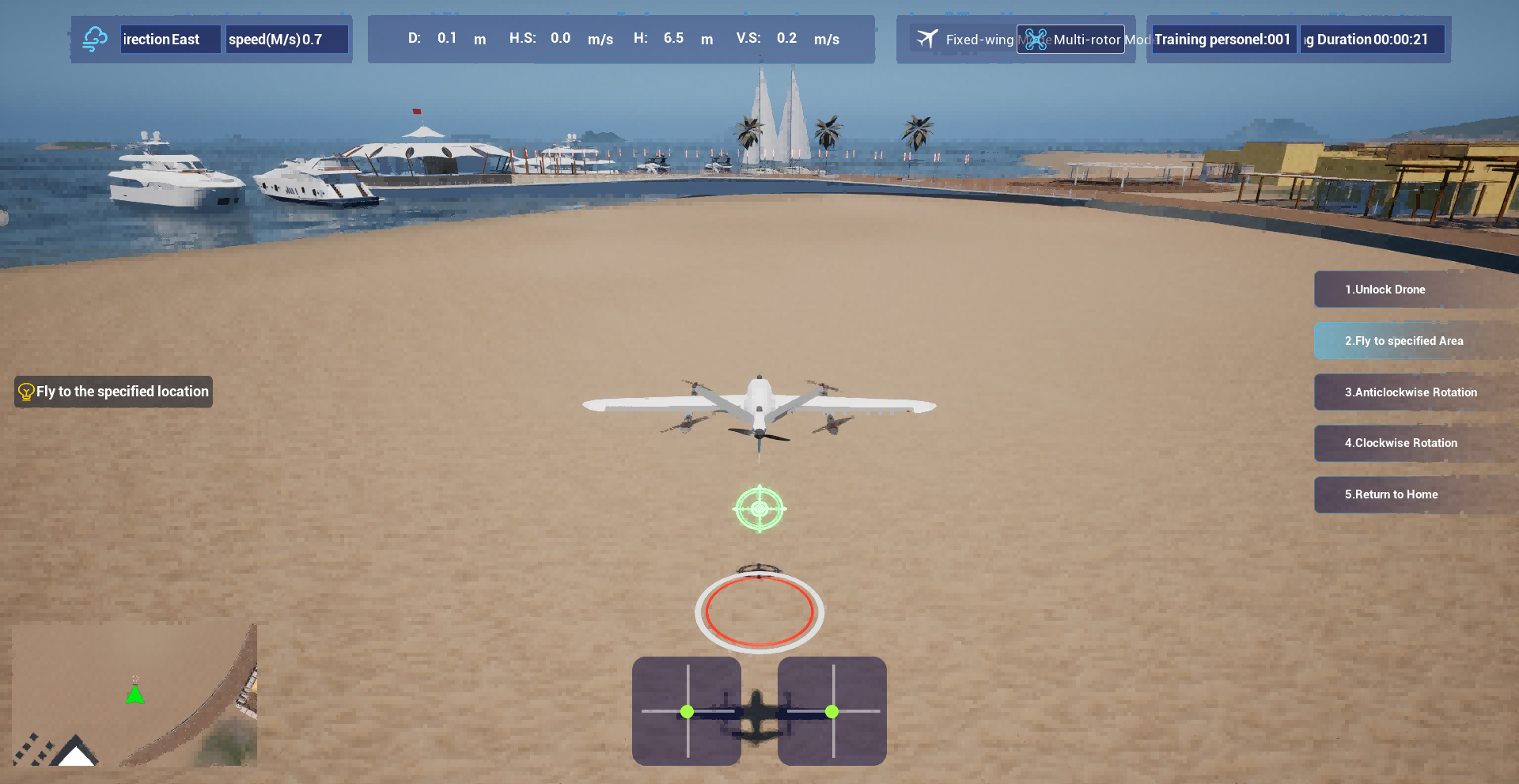
Chinese UAV simulators routinely push pilots through multi-hour drills on the hover-to-cruise transition, and the reason has little to do with basic stick skills. This phase forces a rapid shift in aerodynamic behavior: rotor lift drops as forward speed builds, fixed-wing surfaces take over, and the flight controller must blend two radically different control laws without a single frame of instability. For a trainee, that means relearning muscle memory every few seconds—pitch attitude climbs, throttle response changes, and yaw authority shrinks while lateral gusts start mattering more. Hours of repetition are the only way to make these corrections instinctive before touching real hardware.
Beyond physics, the hours reflect a deliberate training philosophy. Chinese UAV programs often operate mixed fleets where a single operator manages multiple airframes, each with its own transition profile. Sims compress hundreds of edge cases—crosswind shear, sensor dropout, asymmetric payload shifts—into the hover-to-cruise window because that is where accidents cluster in field data. A pilot who can hold a clean transition in degraded conditions frees up instructors to focus on mission tactics rather than basic airmanship. So the sim clock isn't about punishing trainees; it is about grinding down the failure rate in the one maneuver that separates a surveillance loiter from a controlled crash.
Ground effect modeling that surprises first-time vertical pilots
Most first-time vertical pilots expect the machine to settle predictably as they descend, but the extra cushion of air trapped beneath the rotors changes everything. A well-tuned ground effect model doesn't just add a fixed lift bonus—it shifts with rotor diameter, disc loading, and surface type, so landing on tall grass feels noticeably different from touching down on asphalt.
The surprise usually comes during the last two meters. Collective inputs that felt linear in free air suddenly produce a mushy, delayed response, and the aircraft may drift sideways as the downwash spreads unevenly. Modeling this properly means treating ground effect as a dynamic pressure field rather than a simple scalar multiplier, so pilots have to relearn their flare timing instead of relying on altitude readouts alone.
For simulators, that fidelity is what separates a training tool from a game. If the model ignores rotor wash interaction with nearby obstacles or fails to reduce ground effect over permeable surfaces like gravel, pilots build false confidence. Once they transition to a real vertical platform, the first low hover becomes an unplanned lesson in aerodynamics rather than a smooth arrival.
Practicing asymmetric thrust before it happens in the field
Simulating an engine failure during cruise or climb-out isn't enough if you always keep the rudder inputs gentle and predictable. Real asymmetric thrust hits suddenly—often right after rotation or during a go-around when you're already task-saturated. Set up scenarios where the instructor cuts a throttle without warning, then forces you to hold heading and altitude for a full thirty seconds before touching anything else. That delay builds the muscle memory to keep the ball centered while your brain catches up.
Once you can hold the line, add the unexpected second failure or a crosswind. Many pilots practice single-engine work in calm conditions, but the field won't hand you that luxury. Fly the pattern with one engine at idle and a stiff crosswind from the dead side, then change the wind direction on the next circuit. You'll learn that the rudder trim setting that worked last time is useless now, and that your feet need to read the yaw string, not a checklist.
Reading the windsock wrong during crosswind landings
One of the most persistent mistakes pilots make during crosswind landings is treating the windsock as a precise, real-time wind vector for the touchdown zone. A windsock only shows the surface wind at its own location, which can be shielded by hangars, trees, or terrain. By the time you cross the threshold, that breeze may have shifted or gusted, so fixating on the sock's angle from the turn to final often sets you up for a correction that is already stale.
Another common error is misreading the direction itself. The windsock points away from the wind, not into it, and in a tense crosswind moment, even experienced pilots can mentally invert this. You might see the sock streaming to the left and mistakenly add right rudder, thinking the wind is coming from the right. That reversal during the flare is enough to push you sideways off centerline before the tires touch.
Crosswinds also fool pilots because the sock's droop angle seems to promise a mild component when the gusts are actually strong and rolling. A partially lifted sock can indicate 5 knots or 15, depending on its design and age. Rather than trusting one glance, compare the sock with the winds aloft, your crab angle, and the runway edge markers. If the sock is twitching between directions, expect the crosswind to pulse, and be ready to keep the upwind wing low without overcorrecting.
Beyond basic tutorials, advanced VTOL scenarios hidden in the software
Most people stop at the built-in tutorials and never explore the event-trigger menus that unlock complex transitional maneuvers. Flight controllers often ship with hidden test cards for semi- and fully-coupled hover-to-forward-flight transitions, including single-engine-out during tilt-rotor conversion. These are not documented in the quick-start guide but are accessible through the diagnostic or advanced flight mode panels.
Beyond simple waypoint missions, the software includes dynamic failure injection scenarios. You can force a rear motor loss at 60% transition, introduce progressive sensor drift, or simulate a GPS-denied environment while the aircraft is mid-takeoff. The real value comes from replaying these scenarios with the control loop gains tuned differently, observing how the autopilot compensates or fails.
Some builds include maritime recovery drills: landing on a heaving deck with a moving landing pad, or executing a wave-off and go-around at 3 meters above the surface. Others expose high-density altitude takeoffs and low-battery return-to-base with unexpected headwinds. These hidden scenarios are usually buried behind a debug flag or a long-press on the "advanced" icon.
FAQ
The training goes well past hovering and touch-downs. You can work on transition maneuvers between hover and forward flight, engine-out landings in confined areas, pitch and roll control during gusty crosswinds, and emergency recovery from unstable descent. Each session logs your control inputs so you can see exactly where you overcorrected or lost altitude.
Yes, but expect a real learning curve. The basic tutorials start with throttle management and orientation drills, then gradually introduce collective and cyclic-style inputs. If you have zero experience, plan to spend a few hours just on the hover trainer before attempting a full mission profile.
You can set custom wind speed, direction, and gust frequency, including rotor wash effects near buildings or terrain. During the transition from vertical lift to wing-borne flight, the model reacts to crosswinds realistically, so you have to manage tilt and power carefully. There are also thermal and density altitude presets for mountain and desert environments.
Most USB controllers and standard RC transmitters with a dongle work fine. The software detects common brands automatically, and you can remap every channel, set exponential curves, and adjust stick sensitivity. A gamepad is usable, but you won't get the same precision as a proper transmitter with longer sticks.
The flight model is built around real Chinese VTOL platforms, so it includes specific aerodynamic quirks like ducted fan momentum drag and lift loss during rapid pitch changes. You also get authentic ground control station layouts and radio telemetry readouts, not just a generic cockpit view.
It features several unlicensed civilian-style VTOL UAVs inspired by public concepts from Chinese manufacturers, but no classified military airframes. The models are detailed enough for procedural training, with accurate weight, rotor diameter, battery endurance, and payload effects, without copying proprietary data.
You can trigger partial power loss, single motor failure on multirotor configurations, control surface jams during transition, and sensor dropouts. Each scenario forces you to decide between ditching, autorotation-style descent, or trying a rolling landing. The post-flight replay shows exactly which control inputs led to instability.
Conclusion
The real test inside a China VTOL UAV simulator rarely arrives during basic lift-offs. It comes when you shift from a stable hover into forward flight, a tiltrotor transition that quietly separates confident pilots from hesitant ones. Many Chinese simulators devote entire training blocks to this hover-to-cruise switch, and for good reason: a rushed transition can bleed altitude, yaw unexpectedly, or stall a rotor before it fully tilts. Another layer that catches first-time vertical pilots is ground effect modeling. Hovering low feels deceptively easy, yet the moment you climb out of that cushion, the aircraft demands more power and a steadier collective. Toss in asymmetric thrust practice for engine-out or rotor-damage scenarios, and the software starts to feel less like a game and more like emergency preparation. These aren't hidden test questions; they're core habits.
Crosswind landings expose a different weakness, often starting with a simple windsock misread. Pilots who line up based on intuition instead of actual wind direction tend to drift sideways, overcorrect, and then land hard on one wheel. The simulator's crosswind module punishes that mistake almost every time. Beyond the basic tutorials, advanced VTOL scenarios sit tucked inside mission menus, often unlocked only after logging enough flight hours or passing specific transition drills. You might find yourself flying a loaded tiltrotor to a rooftop pad in gusty conditions, or managing a partial power failure right at the moment of conversion. These scenarios turn abstract warnings into muscle memory, which is exactly what makes the China VTOL UAV simulator a serious tool for mastering vertical takeoff and landing rather than just another crash-and-reset arcade.
Contact Us
Contact Person: Niles Liu
Email: [email protected]
Tel/WhatsApp: 8619945009803
Website: https://srizfly.com/