

Best Quality Calcium Sulfate Antistatic Floor Systems and Their Core Advantages for Modern Facilities
2026-11-22
When a facility's operations depend on precise electronics, even a small static discharge can trigger costly downtime. Calcium sulfate antistatic floor systems have become a go-to solution for modern control rooms, data centers, and clean manufacturing environments where stability and conductivity must coexist. Yet not all raised access floors are engineered the same. Lipin Floor has focused on refining the material composition and load-bearing structure behind these systems, making it easier for facility managers to select a surface that performs reliably under heavy equipment and constant foot traffic. This blog breaks down the core advantages that separate high-quality calcium sulfate antistatic flooring from standard alternatives, and what to look for before your next specification.
Calcium Sulfate Panels as a Denser and Flatter Antistatic Foundation
Calcium sulfate panels bring a noticeably higher mass to raised access flooring, which changes how the floor behaves under foot traffic and rolling loads. The dense core absorbs vibration and reduces deflection more effectively than many lighter panel options, so equipment racks and sensitive instruments sit on a surface that feels solid rather than springy. That extra weight also helps with acoustic dampening in busy control rooms and data halls where noise from rolling carts or shifting chairs travels easily through the floor.
Flatness is another reason these panels are chosen for antistatic foundations. The manufacturing process produces a consistently smooth, level face with tight dimensional tolerances, which matters when servers, medical devices, or laboratory benches need full contact with the floor. Even small gaps or uneven edges can create pressure points or interfere with leveling feet, and the uniformity of calcium sulfate reduces the time spent shimming and adjusting after installation.
The antistatic performance comes from a controlled surface layer or integrated additives that allow static charges to drain away before they build up around sensitive electronics. Combined with the panel’s density, this creates a stable, grounded foundation that holds its shape over time instead of bowing at the edges. For facilities that need both physical stability and reliable static control, the denser, flatter calcium sulfate panel often becomes the practical benchmark.
Load-Bearing Performance Without Losing Static Dissipation Consistency
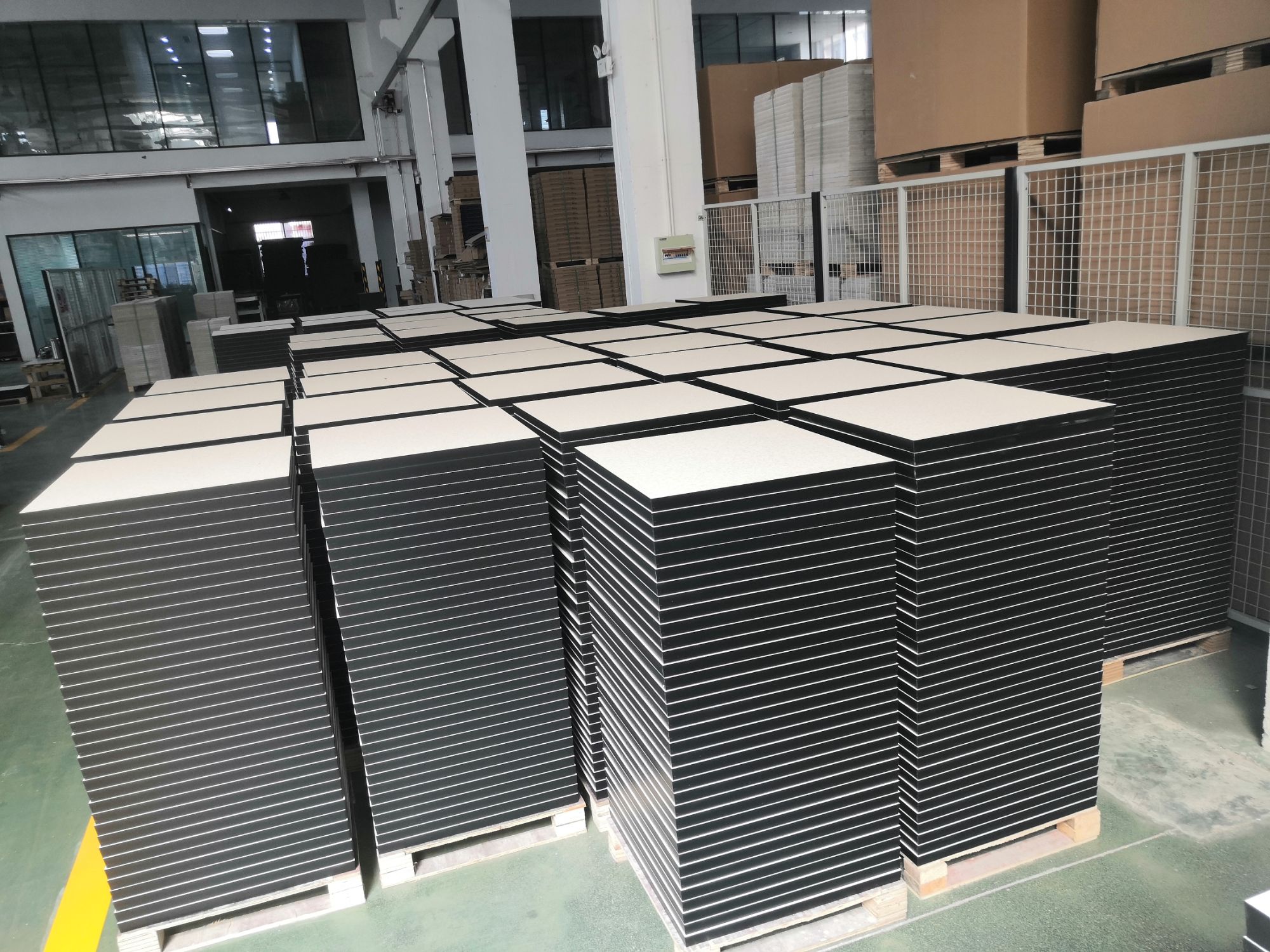
Keeping a floor or work surface flat under heavy rolling loads usually works against the very network that carries away static charge. Most conductive fillers form thin, brittle pathways through a polymer; once the slab flexes or a pallet jack grinds across it, those pathways crack and the dissipation values start drifting. The trick is not adding more carbon, but changing how the load path is distributed so the conductive structure stays intact under compression rather than being torn apart.
In practice, this means using a denser core or a modified resin package that lets the surface take point loads without pressing the dissipative layer into isolation. The top layer is designed to wear slowly, keeping the resistance reading stable between 10^6 and 10^9 ohms even after repeated passes with metal-wheeled carts. That stability matters more than the initial number; a floor that reads fine on day one but spikes after a few months creates exactly the kind of hidden ESD risk that slows down production lines.
Testing therefore covers more than a simple surface-point measurement. Panels are cycled under weighted rollers, then rechecked for both resistance and mechanical set. The goal is a floor or worksurface that does not ask the facility to choose between supporting heavy equipment and protecting sensitive electronics. When the two properties are engineered together, the material performs quietly in the background, without constant monitoring or special operating rules.
Dimensional Stability in Environments Where Temperature and Humidity Shift
Most materials move in ways that are easy to ignore until the air itself starts swinging between dry and damp, warm and cool. The problem is rarely a single number like a coefficient of expansion; it is the mismatch between layers, grain directions, or joined parts. A panel may stay flat in a steady room, then cup after a few weeks of intermittent humidity because one face absorbs moisture faster than the other. That kind of asymmetric movement often produces more visible distortion than an overall size change.
Temperature effects can be surprisingly quick, but they tend to relax once the material reaches a uniform temperature. Humidity-driven change is slower and lingers longer, especially in cellulosic and polymer-based materials. A useful mental model is to separate elastic movement, which reverses, from inelastic movement, which does not. Thin coatings, adhesive lines, and fasteners all sit somewhere on that spectrum, and if they do not shift together, the interface becomes the failure point rather than the bulk material.
Designing for dimensional stability is less about finding an inert material and more about managing gradients and restraint. Ventilation behind a panel, relief cuts, balanced layering, and allowing for movement at joints often do more than specifying a premium substrate. In practice, a well-chosen gap or a flexible bond line absorbs the strain that would otherwise turn into warp, cracks, or fasteners pulling loose.
Moisture and Fire Resistance for High-Traffic Modern Facilities
Entrances, corridors, and shared lobbies in busy commercial buildings take a beating from wet shoes, rolling carts, and daily cleaning routines. Materials that look good on a sample board often fail once moisture gets underneath, causing warping, staining, or adhesive breakdown. Choosing dense, non-porous surfaces such as polished concrete, porcelain tile, or sealed commercial vinyl helps keep water from working its way into the subfloor and reduces the need for frequent repairs.
Fire performance carries a different set of demands in these spaces. High foot traffic usually means wider exit routes, larger open areas, and strict code requirements for flame spread and smoke generation. Wall panels, ceiling systems, and floor coverings should be selected not just for their surface durability but for how they behave in a real event. Products with low smoke emission and limited flame propagation can buy critical time during evacuation while also meeting the demands of insurers and local inspectors.
The practical overlap between moisture and fire resistance is often overlooked. A floor that resists water penetration but uses combustible backing can still create risk, just as a fire-rated core can underperform if edges swell after repeated wet mopping. In active facilities, it makes sense to look at full assembly performance—substrate, adhesive, transitions, and finish—rather than relying on a single test report. That approach avoids unpleasant surprises after the building is already in daily use.
Grounding Reliability in Cleanrooms Labs and Data-Dependent Spaces
In cleanrooms and labs where data integrity depends on stable equipment behavior, grounding failures rarely announce themselves with a spark. They show up as drifting sensor baselines, intermittent communication faults, or subtle waveform distortion that gets blamed on software. A reliable ground reference isn't just a safety checkbox; it's the quiet foundation that keeps particle counters, mass spectrometers, and environmental monitoring chains from lying to you in small, cumulative ways.
The usual mistake is treating the building's structural steel or a random conduit as an acceptable return path. In practice, galvanic differences between copper, aluminum, and coated structural members create millivolt-level offsets that are meaningless for power distribution but disastrous for microvolt and nanoamp signals. Dedicated, insulated grounding conductors routed back to a single validated earth point reduce these loops. Regular measurement of ground-to-neutral voltage and impedance under actual operating loads reveals degradation before it contaminates a batch or invalidates a calibration record.
Data-dependent spaces add another layer: the same ground that references an analog input also influences the noise floor of networked instruments and storage arrays. Isolation transformers, signal reference grids, and careful separation of dirty grounds (motors, compressors, UPS switching) from clean grounds (instrumentation, data acquisition) are not optional extras. When a lab treats grounding as a living system subject to drift, corrosion, and retrofit mistakes, it stops chasing phantom anomalies and starts trusting the numbers it archives.
Installation and Maintenance Advantages That Reduce Long-Term Operating Costs
Perhaps the most overlooked cost factor is how quickly a system can be installed without disrupting existing workflows. Components that arrive pre-assembled or use uniform connection points cut labor hours on day one, and that initial saving compounds when future adjustments don't require specialized crews or extended downtime.
Routine upkeep follows the same logic. Fewer wear parts, easily accessible panels, and tool-free service points mean a technician can handle most inspections in a single visit. Over a decade of operation, those shorter service windows translate into less idle equipment and fewer emergency repair invoices.
The real financial benefit shows up in the total cost of ownership. When installation is predictable and maintenance doesn't demand rare expertise, budgets become easier to plan and equipment stays productive longer. That reliability quietly removes the hidden expenses that often make a low purchase price far more expensive in the end.
FAQ
The core material is denser and naturally fire-resistant, and the antistatic performance comes from conductive elements distributed through the panel instead of a thin surface coating. This gives a more stable path to ground while also improving load capacity and dimensional stability.
They handle heavy rolling loads without sagging, maintain a reliable electrical resistance range for sensitive equipment, and stay flat over large areas. The panels also work well with high-density cabling and precision air management layouts.
Because the conductive material is embedded throughout the panel rather than applied as a separate finish, everyday wear does not strip the static control capability. Resistance values tend to remain consistent as long as the floor is kept clean and the grounding grid is intact.
Yes. The high mass of calcium sulfate reduces footfall noise and structural sound transmission more effectively than many hollow steel or lightweight wood core panels, which creates a quieter space without adding extra insulation.
Calcium sulfate offers better fire resistance, lower creep under constant load, stronger screw holding, and no corrosion or moisture-related swelling. It also provides solid underfoot feel and better acoustic damping in occupied spaces.
Yes. Panels can be cut cleanly for air grilles, cable outlets, and custom openings, and the pedestal system allows adjustable cavity depths. This makes them practical for flexible air delivery and frequent reconfiguration of power and data lines.
Regular dust mopping and occasional damp mopping with a neutral cleaner are usually enough. Avoid prolonged standing water, inspect grounding connections during routine walkthroughs, and replace any damaged edge trim or gaskets before they affect surface continuity.
They are especially useful in electronics labs, cleanrooms, hospital operating areas, communication hubs, museum storage, and industrial control rooms where electrostatic discharge control, fire safety, and dependable load performance have to work together.
Conclusion
Calcium sulfate antistatic floors earn their place in modern facilities less through marketing claims than through the way their core panel behaves under real working conditions. The panels are pressed to a higher density than many alternatives, which gives contractors a flatter starting surface and reduces the slight undulations that can create uneven wear or compromise static-controlled pathways. Beneath that surface, the load-bearing structure remains connected to a conductive network, so heavy equipment can roll across the floor without interrupting the static dissipation path. In spaces where temperature and humidity shift between shifts and across seasons, the material resists curling and edge lift, keeping tile joints tight and the electrical path continuous instead of depending on coatings that degrade with time.
That stability carries into demanding settings such as cleanrooms, laboratories, and data halls, where grounding reliability is not a future upgrade but a daily operating requirement. The calcium sulfate core also handles moisture and fire exposure better than many wood-based or lightweight cores, which matters in high-traffic corridors and equipment areas where spills or local heat sources are common. From an operational view, the panels tend to install cleanly and require fewer corrective steps after placement, and their durable surface reduces the need for early replacement or repeated conductivity testing. Over the life of a facility, those small differences show up as lower maintenance budgets and fewer interruptions to critical work.
Contact Us
Contact Person: yuki
Email: [email protected]
Tel/WhatsApp: +86 18664390732
Website: https://www.lipinfloor.com/