

Best Econom Press Brake Machines for Precision Metal Forming
2026-09-30
Precision metal forming often forces a frustrating trade-off: buy a budget press brake that loses accuracy after a few months, or overspend on industrial machines built for jobs you’ll never run. The best econom press brake machines are breaking that pattern — and HUNSONE is one of the names leading the change. If you want tight tolerances without the premium price tag, this guide is for you.
What Sets Econom Press Brakes Apart in Precision Work
Precision on Econom press brakes starts before the tool ever touches metal. The ram runs in hardened, adjustable gibs instead of relying on cylinder alignment alone, and the frame is stress-relieved after welding to keep deflection under a few microns across the full working length. A mechanical crowning table works in tandem with linear encoders near the die, so the machine compensates for bed flex without a delayed software correction. Long panels come out with the same angle at the ends as in the middle.
Repeatability matters more than a single perfect bend. Econom's closed-loop hydraulics use position feedback from the ram, not a fixed timer, to hold speed steady through thick and thin sections. That prevents overshoot on acute angles and keeps the bend consistent when material thickness varies within tolerance. Operators don't have to sneak up on a dimension with test pieces; the first part off the stack usually matches the last one.
Tool changes are where many press brakes lose their accuracy. Econom machines use a ground reference ledge and positive stops in the clamping system, so upper tools drop into the same location after every swap. Offline programming reads the actual tool profile and shoulder height rather than pulling from a generic library. That means setup errors from mismatched punch and die data are avoided, and the machine holds angular accuracy without shimming or re-zeroing between jobs.
The Core Engineering Behind Repeatable Bending Accuracy
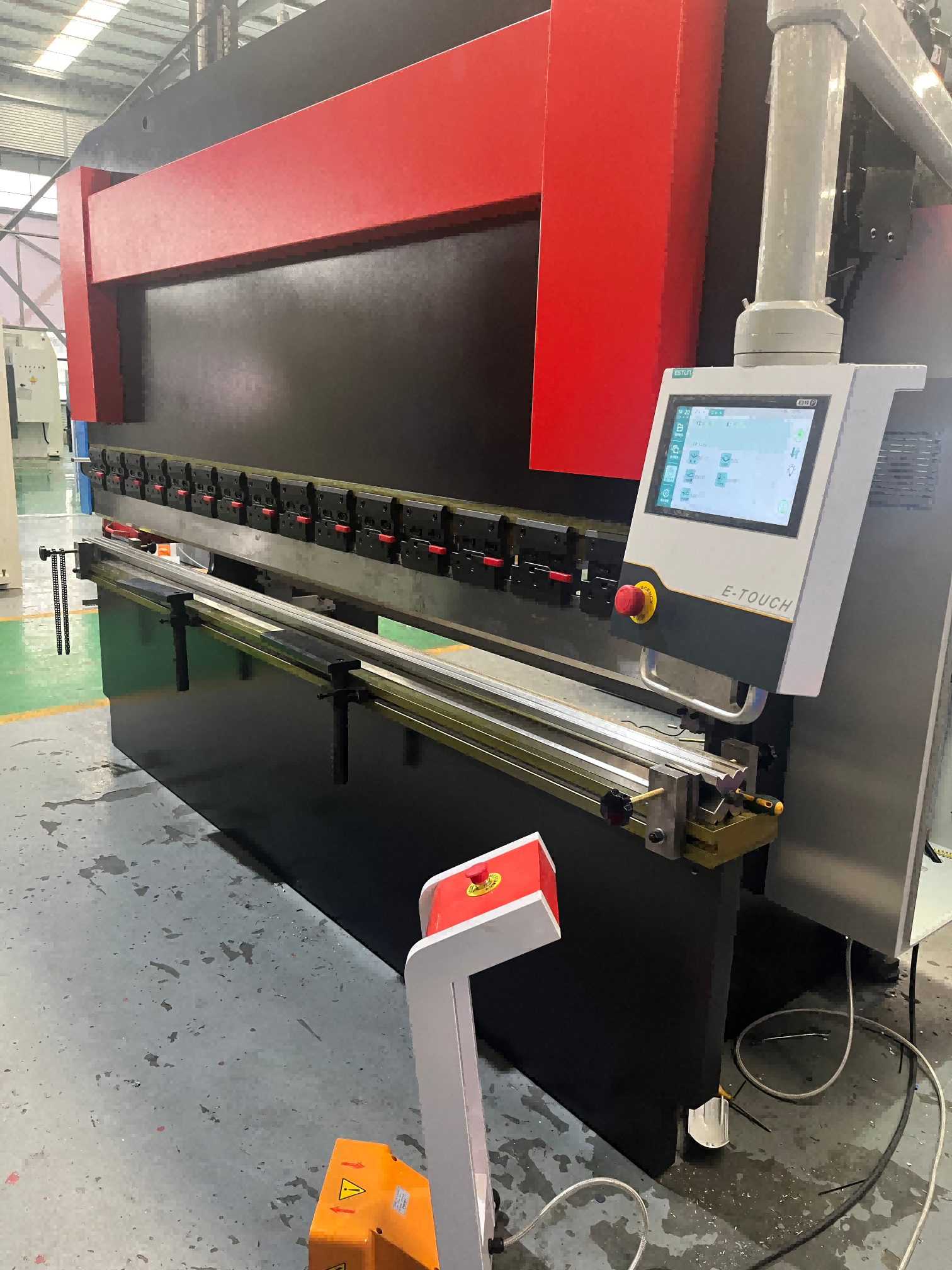
Repeatable bending accuracy rarely comes from a single clever component. It is the cumulative result of how the frame resists deflection, how the ram guides are aligned under load, and how the control system compensates for thermal drift and material springback. On well-built press brakes, the bed and ram are machined as a matched pair, then stress-relieved before final grinding, so that parallelism holds even when the machine is pushed toward its rated tonnage.
The hydraulic or servo-electric drive matters less than the stiffness of the closed loop between the linear encoders and the valve or motor response. If the Y-axis position is measured at the cylinders but the tooling deflects in the middle of the bed, the controller can only guess at the true angle. That is why high-accuracy machines place reference points closer to the load path or use crowning systems that actively counter deflection based on measured force distribution, not just a preset table.
Material behavior introduces a separate challenge. Springback varies with grain direction, sheet thickness tolerance, and even the time between forming operations. Machines that hold tight repeatability over hundreds of parts don't simply rely on a single bend angle correction; they sample actual results, adjust the target position for the next cycle, and store those offsets per tooling setup. This closed-loop feedback, combined with stable mechanical geometry, is what separates a machine that occasionally hits the number from one that hits it every shift.
Real-World Performance: Tight Tolerances Without the Usual Trade-offs
In many manufacturing processes, hitting extremely tight tolerances usually means sacrificing speed, material flexibility, or surface finish. But that doesn't have to be the case. With the right combination of toolpath strategy, thermal stability, and real-time feedback, it's possible to hold micron-level accuracy on production runs without slowing down the spindle or adding extra finishing passes. The key is treating the machine, tool, and workpiece as one integrated system rather than isolating each variable.
One common mistake is assuming that a high-precision machine alone guarantees tight tolerances. In practice, things like tool deflection, coolant temperature drift, and even the way a part is fixtured can introduce errors far larger than the machine's stated repeatability. By monitoring cutting forces and adjusting feed rates on the fly, modern systems can compensate for those hidden variables. The result is consistent part dimensions across an entire batch, not just for the first few pieces off the line.
That kind of real-world performance also means fewer rejected parts and less time spent on manual inspection. Instead of chasing tolerances with repeated setups or relying on operator intuition, the process itself becomes inherently stable. When tolerances stop being a trade-off, engineers can design more aggressively, knowing the production floor can actually deliver what the CAD model promises.
Operator-Friendly Controls That Don’t Sacrifice Precision
The best control layouts put the fine adjustment where your hand already rests, not three menus deep. A rotary encoder with a firm detent and a separate coarse/fine toggle does more for real-world accuracy than a high-resolution display ever could. When you can feel each step change, you stop looking at the screen and start watching the workpiece.
Good labeling helps, but physical separation matters more. Grouping feed-rate, spindle-speed, and axis-jog functions by color and shape prevents the kind of half-second hesitation that leads to scrapped parts. Operators don't have to translate abstract icons under pressure; the control's layout becomes muscle memory after a single afternoon.
Durability also plays into precision. A membrane keypad that goes mushy after six months forces harder presses and invites input errors. But a well-sealed pendant or panel with consistent switch travel keeps every entry deliberate. That consistency is what lets an operator hold tight tolerances on the tenth part of a shift just as easily as the first.
Long-Term Value: Build Quality and Upkeep in Daily Use
The real test of any product isn't how it looks on day one, but how it holds up after months of regular use. Sturdy materials, tight tolerances, and thoughtful engineering show up in small ways—hinges that don't loosen, finishes that resist scuffs, and components that stay aligned without constant adjustment. When a manufacturer sweats these details, the item doesn't just survive daily wear; it often becomes more comfortable and familiar over time.
Upkeep plays an equally important role, and good design makes it feel less like a chore. Surfaces that wipe clean with a damp cloth, hardware that's easy to access, and finishes that don't demand specialty products all lower the friction of ownership. That practical simplicity means you spend less time maintaining and more time actually using the item, which is where long-term value quietly accumulates.
Over the years, this combination of solid construction and easy care separates items that are merely purchased from those that are genuinely kept. Instead of replacing something every couple of seasons, you end up with a dependable piece that still works and looks presentable. That kind of longevity doesn't come from a single flashy feature—it comes from the unglamorous, consistent decisions made before it ever reaches your hands.
Matching the Right Econom Model to Your Metal Forming Needs
Choosing an econom model for metal forming starts with a clear view of your production volume and part tolerance. Low-volume prototyping often favors flexible setups with lower tooling costs, while high-volume stamping or extrusion requires a model that prioritizes cycle time and material yield. Pay attention to scrap rates, die wear, and setup time instead of focusing only on upfront price.
For deep drawing or progressive die work, the right econom model balances energy consumption, lubricant use, and press tonnage against the value of the finished part. A model that ignores secondary operations or post-form trimming will understate true cost. Test a few real part geometries through the model before committing to a direction.
Production mix matters just as much. If your shop switches between aluminum, stainless, and high-strength steel, choose an econom model that accounts for changeover and tooling adjustments. The goal is not the cheapest simulation but one that reflects your actual floor constraints and gives you numbers you can act on.
FAQ
Econom press brakes combine rigid frame construction with advanced CNC controls, allowing operators to hold tight bend angles even on complex parts. Their crowning systems compensate for deflection automatically, so repeatability stays consistent across long runs.
Start with your maximum material thickness and bend length. Econom's range spans from compact 40-ton machines for small brackets to heavy 400-ton models for structural plate. Factor in your typical batch size—servo-electric drives make sense for high-mix, low-volume work, while hydraulic versions handle sustained full-power bending.
Yes, but you need to match the tooling and tonnage properly. High-tensile materials spring back more, so you'll want a machine with angle correction feedback. Many Econom controllers include material libraries that adjust the bend depth automatically for different grades.
Daily checks of hydraulic oil temperature and filter indicators, monthly greasing of guide rails and ball screws, and an annual laser calibration of the backgauge and ram parallelism are the essentials. Skipping calibration is the most common cause of gradual accuracy drift.
Most operators pick up the basics within a few days because the interface uses graphical bend sequencing rather than raw code. The system walks you through tool setup, angle correction, and batch counting step by step. For complex multi-bend parts, though, expect a few weeks to become truly efficient.
Sheet metal job shops, electrical enclosure manufacturers, and agricultural equipment builders get the biggest payoff. Anywhere you're forming parts that must fit together with minimal welding or grinding, a precise press brake reduces assembly time noticeably.
Their newer servo-hybrid systems use about 50-60% less power on typical bending cycles because the motor only runs during the actual ram movement, not while waiting at top dead center. Idle consumption drops close to zero, which adds up in multi-shift operations.
Laser light curtains that stop the beam within milliseconds if an operator's hand crosses the point of operation, dual-hand controls, and a mechanical or hydraulic anti-drop valve on the ram are standard. Some models also have a slow-speed approach mode for tricky setup work.
Conclusion
Econom press brakes earn their reputation through a combination of frame rigidity, calibrated hydraulics, and smart crowning systems. The welded steel frames resist deflection under load, which keeps the ram and bed aligned during every bend. Unlike machines that rely on constant manual correction, Econom's control loop samples position and pressure in real time, compensating for material springback and thickness variation. This shows up in production runs where a 0.2 mm tolerance is held across hundreds of parts without drifting. The result is not just accuracy on a spec sheet, but repeatable accuracy when the operator is moving fast and the shop floor is busy.
On the control side, Econom keeps the interface straightforward: tool setup, angle correction, and backgauge moves are handled with clear prompts rather than buried menus. That lowers the learning curve while still allowing fine adjustments for tricky profiles like deep boxes or hemmed edges. Build quality also matters for daily use; linear guides are protected, seals are rated for high cycle counts, and routine maintenance points are easy to reach. Over years of service, that translates to less downtime and fewer recalibrations. When matching a model, shops should look beyond tonnage to bed length, stroke, and optional features like CNC crowning or segmented tooling, because the right combination depends on the material mix and typical bend lengths.
Contact Us
Contact Person: James Chen
Email: [email protected]
Tel/WhatsApp: 86 13770803946
Website: https://www.hunsone.com/