
Best Cutter Suction Dredger Company: Your Top Partner for Efficient Dredging Projects
2026-05-26
When it comes to large-scale dredging, efficiency and reliability aren’t just goals—they’re necessities. Every project, from land reclamation to harbor deepening, demands a partner who brings both cutting-edge technology and real-world expertise. That’s where YaKai Dredger stands apart. As a trusted name in cutter suction dredgers, we don’t just build machines; we deliver complete solutions that keep your project on time and on budget. In this blog, we’ll explore what makes us the go-to choice for contractors worldwide—and why the right dredger can make all the difference.
Precision That Redefines Dredging Standards
Dredging once relied on broad-stroke methods that moved mountains of sediment with little regard for the fine line between progress and ecological disruption. Today, that line has been sharpened by a new generation of systems that read the underwater terrain with millimeter-level accuracy. Real-time kinematic positioning, adaptive cutting heads, and AI-driven suction control work in concert, allowing operators to target specific layers with surgical precision. The result is a dredging process that extracts only what’s necessary, leaving surrounding habitats undisturbed and creating profiles so exact they seem drawn by a geometer’s hand.
This shift transcends mere technical improvement—it alters the very philosophy of marine construction. Vessels now adjust to shifting currents and sediment densities on the fly, maintaining vertical tolerances that were unthinkable a decade ago. Such precision minimizes over-dredging, slashes material handling costs, and transforms reclamation projects into feats of silent accuracy. Stakeholders no longer measure success in cubic meters moved, but in the invisible precision that safeguards both budgets and benthic ecosystems.
Beyond the immediate job site, this redefinition of standards ripples through permitting processes and long-term asset resilience. Regulators, once skeptical, begin to see precision as a cornerstone of responsible development. Ports deepen without compromising adjacent shorelines, and navigational channels stay open longer with less maintenance. The new benchmark isn’t just about doing more with less—it’s about proving that delicate environments and industrial ambition can coexist, one precisely placed grain at a time.
Tailored Solutions Without the Cookie-Cutter Approach
Every business has its own rhythm, challenges, and aspirations. That’s why we leave behind the rigid, one-size-fits-all playbooks. Instead, we start by listening—really listening—to what makes your organization tick. From the nuances of your team dynamics to the specific friction points in your daily operations, we craft a strategy that feels less like an off-the-shelf product and more like a natural extension of your vision. There’s no forced fit, only a thoughtful alignment designed to evolve as you do.
Standardized solutions can only take you so far before they start chafing against the edges of your reality. We believe the most effective approaches are those that breathe with your business, flexing where needed and holding firm where it matters. Our process is iterative and deeply collaborative, blending your insider knowledge with our outside perspective. The result isn’t a generic fix but a living framework that adapts to seasonal shifts, market pivots, or internal growth spurts without losing its core integrity.
Generic answers often address symptoms while leaving root causes untouched. What we deliver isn’t a cloned strategy from a past project but a bespoke response shaped by your unique context. It’s the difference between borrowing someone else’s map and drawing your own with a guide who knows the terrain intimately. No two solutions we design look the same, because no two clients we serve are identical. That’s the promise behind doing away with the cookie-cutter—you get a design that fits your shape, not one that forces you to reshape yourself around it.
Next-Gen Vessels Engineered for Real-World Challenges
Modern maritime operations demand more than just horsepower—they require vessels built to thrive where others falter. Our next-generation designs integrate reinforced hull architectures with adaptive propulsion systems that automatically calibrate to shifting sea states. From ice-choked polar routes to corrosive tropical waters, every weld and circuit is engineered to handle the extremes without compromising speed or fuel efficiency.
We moved beyond simulation-heavy development cycles and instead spent eighteen months stress-testing prototypes in actual gale-force conditions and uncharted shallows. The result is a fleet that reads the ocean intuitively. Hull sensors feed real-time data to onboard AI, adjusting ballast distribution and trim angles before stress accumulates on the structure. This isn’t just durable construction—it’s a dynamic partnership between the vessel and the environment.
Operators accustomed to costly maintenance intervals will notice a deliberate absence of overcomplicated subsystems. Every component is accessible within two steps of the main corridors, and critical systems feature redundant isolation points that allow repairs without dry docking. It’s the difference between engineering that looks good on a CAD screen and engineering that keeps crews safe when the nearest port is a week away.
Where Timelines and Budgets Actually Align
There’s a sweet spot in every project where the schedule stops fighting the financial plan and they start moving together. It’s rarely at the beginning, when optimism inflates deadlines and lowballs costs. Nor is it at the end, when exhaustion and sunk costs blur judgment. Instead, it usually appears somewhere in the middle—after the team has stumbled enough to learn what’s truly necessary, but before external pressures force shortcuts that create expensive rework later. In that window, estimates become grounded, and the budget shifts from a wish list into a real allocation of time and resources.
What makes this alignment possible isn’t a better piece of software or a stricter methodology. It’s the accumulation of small, honest decisions. When someone admits a feature is taking twice as long as hoped, and the response is to adjust expectations rather than hide the delay, the relationship between time and money tightens naturally. Each transparent trade-off—cutting one element to protect another, extending a phase to avoid technical debt—pulls the plan closer to reality. Over time, the gap between what was promised and what actually happens shrinks, not because predictions improve, but because the conversations around them grow more truthful.
The most reliable projects don’t succeed because they nailed the initial numbers. They succeed because the people involved learned to stop treating the timeline and budget as separate challenges. Instead, they start treating them as two facets of the same problem: how much value can you deliver, and how long are you willing to wait for it? When that mindset takes hold, you stop talking about catching up and start making steady progress. That’s where real alignment lives—not in a chart or a contract, but in a team’s ability to face the mess together and keep moving forward.
Stories from the Seabed: Our Project Archives
Digging through the old storage drives felt like unearthing a time capsule. Between outdated spreadsheet formats and corrupted video files, we found hand-scrawled dive logs from a 2003 expedition to the Puerto Rico Trench. One entry described a bioluminescent octopus that nobody had seen before or since. The paper was water-stained, the ink smudged with what looked like squid ink. Our team had completely forgotten about it until now.
Then there’s the box of rusted sample jars from the forgotten 1990s Black Sea wrecks project. Most labels had peeled off, but one still clung on: “Fabric fragment—possibly Byzantine.” Under a microscope, it turned out to be a scrap of medieval sailcloth, still smelling faintly of brine and burnt wood. We found a yellowed photograph inside the jar’s lid, showing a grinning crew member holding the cloth up to the ROV’s camera. Nobody remembers his name, but the joy is timeless.
These archives aren’t just curiosity pieces. Last week, a student intern matched the octopus log with a blurry sonar anomaly from a 2019 survey in the same region. Suddenly, a decade-old mystery sparked a fresh hypothesis. The seabed doesn’t give up its stories easily, but sometimes, the dusty corners of our own office shelves hold the key.
Partnership, Not Just a Service Agreement
Our approach goes far beyond a standard contract—we embed ourselves in your vision as a genuine strategic partner. From day one, we work alongside your team, sharing insights that help refine your goals and uncover hidden opportunities. This isn't about handing off tasks and waiting for results; it's a collaborative journey where your success becomes our own metric of performance.
Every relationship is built on transparency, mutual trust, and a shared roadmap. We avoid rigid transactional mindsets by co-creating milestones that adapt to your evolving needs. Whether it's pivoting strategy mid-project or exploring an unconventional solution, our flexible structure treats challenges as shared puzzles to solve together.
The difference shows in the details: proactive advice during quiet periods, celebrating wins as if they were our own, and a genuine stake in your long-term trajectory. By choosing us, you're not signing up for deliverables—you're gaining a dedicated ally committed to pushing boundaries right alongside you.
FAQ
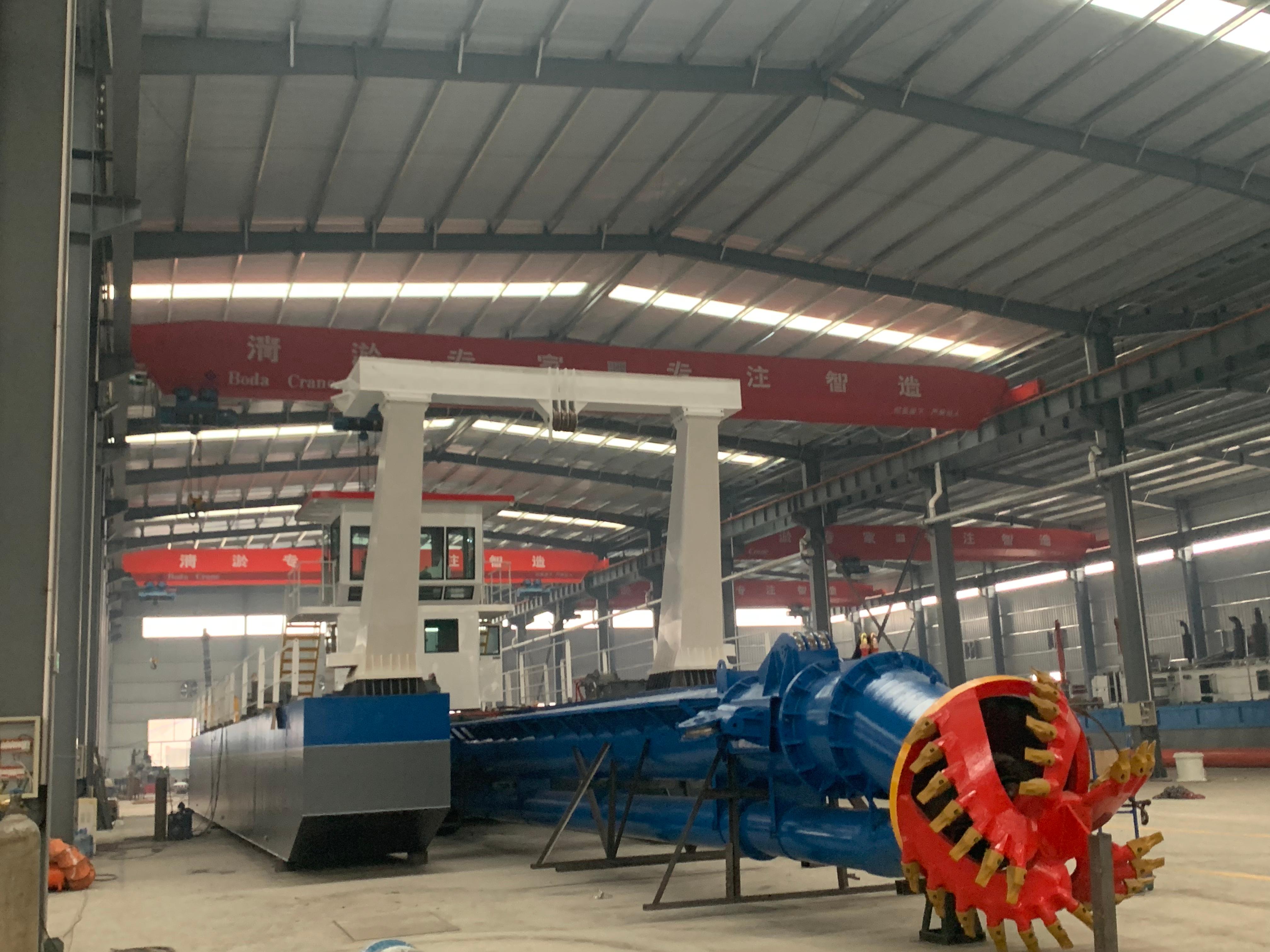
A cutter suction dredger uses a rotating cutter head to break up hard soil or rock before suction, making it ideal for compacted materials, clay, or weathered rock. Unlike trailing suction hopper dredgers that rely on dragheads, CSDs can handle more stubborn seabeds and deliver precision in cutting and transporting material through a pipeline to a disposal site.
Assess the soil composition and project depth. If you're dealing with cohesive soils, compacted sand, or need to create precise trenches or channels, a CSD is likely the right choice. It excels in projects like port deepening, land reclamation with hard materials, or pipeline trenching where accurate profile cutting is required.
Our dredgers are built to manage a wide spectrum: from soft silt and sand to hard clay, gravel, and even moderately rock formations. The cutter power and tooth configuration can be tailored to match the specific soil characteristics, ensuring continuous, efficient operation without excessive downtime.
Absolutely. Every waterbody and project presents its own challenges. We work closely with your engineering team to customize cutter power, ladder length, discharge distance, and even automation features. Whether it's extreme weather conditions, shallow waters, or long-distance sediment transport, we adapt the design to your operational reality.
Efficiency comes from a combination of hydraulic optimization, durable wear components, and smart monitoring systems. We integrate advanced pump designs for higher concentration mixtures, use wear-resistant steel on critical parts, and include real-time production monitoring so operators can tune parameters instantly. This cuts fuel consumption and maximizes uptime.
We deliver ongoing partnership, not just a machine. Your package includes commissioning assistance, operator training, on-site troubleshooting, and a readily available supply of spare parts. Many clients also benefit from our preventive maintenance programs, which help extend the dredger's lifespan and avoid unplanned breakdowns.
Because we prioritize your project outcome over just selling equipment. With decades of hands-on dredging experience, we understand the nuances that general machinery builders miss. Our designs evolve from real-world feedback, and our support team stays with you from launch to final cubic meter. You're getting a partner that invests in your success.
Conclusion
True dredging expertise isn’t just about moving sediment—it’s about reshaping waterways with a level of precision that quietly redefines what’s possible. Our approach throws out the industry’s one-size-fits-all playbook, treating every project as a unique terrain that demands its own strategy. It’s why our engineers don’t just drop a standard vessel onto your site; they reimagine it, pairing next-generation cutter suction dredgers with onboard systems that adapt to unpredictable soil layers, tight environmental windows, and the kind of real-world chaos that can sink a schedule. The result? Budgets that don’t bloat and timelines you can actually anchor to, because we’ve replaced guesswork with granular planning and vessels that perform like they were born for your seabed.
But the hardware is only half the story. What truly sets us apart is a mindset that treats every engagement as a joint venture, not a transaction. We’ve built archives of hard-earned lessons from river deltas, port expansions, and land reclamation projects across the globe—stories etched into our work, not just our brochures. These experiences inform a partnership model where your constraints become our blueprint, and the conversation doesn’t end when the contract is signed. Whether it’s navigating sudden coral outcroppings or accelerating a phase to beat a monsoon, we’re shoulder-to-shoulder with your team, solving problems before they surface. When you choose us, you’re not hiring a dredging company; you’re gaining a partner who’s as invested in the outcome as you are, with a fleet that turns your project brief into a benchmark for the industry.
Contact Us
Contact Person: Nancy
Email: [email protected]
Tel/WhatsApp: (+86) 13869631558
Website: https://www.yakaidredger.com/